+86-25-8470-5507


Views: 0 Author: Site Editor Publish Time: 2026-06-22 Origin: Site


The basic physics of moving fluid manually might seem incredibly simple at first glance. You move a lever, and liquid flows. However, misunderstanding these internal mechanics often leads to poor procurement decisions, severe fluid contamination, or premature equipment failure. We designed this article not just as a theoretical physics lesson. Instead, it serves as a practical, technical evaluation guide for engineers, technicians, and facility managers.
You need to understand how these devices behave under real-world stresses. They operate in harsh environments where performance margins remain tight. Evaluating them requires looking beyond basic function. Matching the exact internal mechanism—whether piston, rotary, or diaphragm—to your specific operational requirement is the only way you can ensure consistent reliability and safety compliance. By the end of this guide, you will know exactly how to match mechanical transfer principles to your industrial fluid needs.
Every manual fluid transfer system operates on one foundational principle. It creates a localized vacuum. When you actuate the handle, you physically expand a sealed chamber inside the housing. This expansion creates a low-pressure zone. You do not actually pull the liquid upward. Instead, the heavier atmospheric pressure pushing down on the fluid source forces the liquid into this new void.
Creating a vacuum achieves nothing if the fluid simply falls back down. This is where check valves become critical. They serve as one-way gates within the system. You will typically find an inlet valve and an outlet valve. These components prevent backflow entirely. They successfully turn reciprocal motion—moving a lever up and down—into directional, forward fluid movement. If debris compromises these valves, the entire system stops functioning.
Understanding the actual movement requires breaking the process into two distinct operational phases. They dictate the rhythm and efficiency of the transfer.
Expert technicians know system efficiency depends entirely on the integrity of the airtight seal. The pumping chamber must remain perfectly sealed against external air. Even minor tolerance gaps drastically reduce your flow rate. If air leaks past the internal O-rings, the vacuum drops. The atmospheric pressure will no longer have the leverage to push heavy liquids up the pipe. Regular seal inspection remains the best practice to prevent this insidious pressure loss.
Engineers categorize these devices based on their internal moving parts. Different mechanisms handle distinct physical challenges. You must match the category to your specific industrial application.
These devices represent the most traditional design. They rely on linear motion to do the heavy lifting.
This design ditches linear motion in favor of a smooth, circular action. It provides a much different user experience and flow profile.
When you deal with heavily contaminated fluids, traditional moving parts fail. The diaphragm mechanism solves this specific problem.
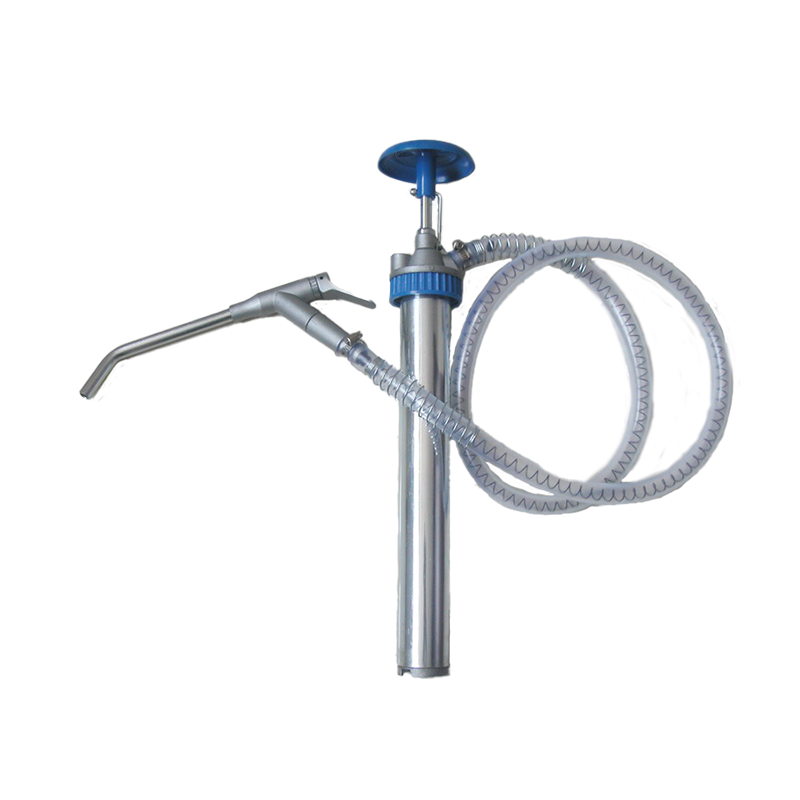
Selecting the right equipment requires looking beyond the basic price tag. You must evaluate fluid dynamics, material chemistry, and human factors. A poor choice here leads to rapid failure.
You must evaluate your options based on fluid resistance. Viscosity measures how much a liquid resists flowing. Water flows easily. Cold gear oil fights movement. This dynamic explains why a specialized Hand Pump requires different internal tolerances. Pumping heavy oil demands specialized leverage ratios compared to a standard water pump. If you use a water-rated device for thick syrup, the handle resistance will break the internal lever arm. Always check the maximum centipoise (cP) rating before finalizing a purchase.
Matching wetted materials to the chemical you plan to move is non-negotiable. Wetted materials include any part touching the fluid. If you mismatch these elements, the chemicals will dissolve the pump from the inside out.
| Pump Material | Best Suited Fluids | Fluids to Avoid |
|---|---|---|
| Cast Iron / Steel | Oils, Diesel, Lubricants | Acids, Corrosive chemicals, Water (rust) |
| Polypropylene (Plastic) | Acids, DEF, Water, Mild chemicals | Strong solvents, High-temperature liquids |
| Stainless Steel | Food-grade liquids, Aggressive chemicals | Highly concentrated chlorides |
| Viton (Seals) | Aggressive hydrocarbons, Harsh solvents | Ketones, Acetone |
You must analyze the mechanical advantage of the device. This usually appears on spec sheets as strokes per gallon or strokes per liter. Specifying a unit with an inappropriate lever ratio leads to severe operator fatigue. If a technician needs to pump 50 gallons using a tool that moves only 8 ounces per stroke, operational turnaround grinds to a halt. You must balance the volume per stroke against the physical effort required to complete that stroke.
Facility managers must recognize physical limitations transparently. No manual pump scales well for high-volume, continuous daily processing. They are designed for intermittent batch transfers. If your daily volume exceeds specific thresholds—typically more than 100 gallons per day—you are using the wrong technology. At that scale, pneumatic or electric transfer solutions must be evaluated to protect worker health and maintain process efficiency.
Even the best-engineered devices fail if deployed incorrectly. Understanding common implementation risks allows you to build proactive maintenance schedules. You can stop problems before they cause hazardous spills.
Using the wrong fluid actively breaks down internal O-rings. For example, running strong industrial solvents through a standard rubber-sealed mechanism causes rapid degradation. The rubber swells, cracks, and eventually dissolves. This inevitably leads to toxic chemical leaks onto the shop floor. It also causes immediate loss of suction through air intrusion. Cavitation—where vapor bubbles form and collapse violently—can also occur if you attempt to pump highly viscous fluids much faster than the inlet tube can supply them.
You must clarify which types can survive being pumped without liquid. Pumping air is known as dry running. Diaphragm types can run dry indefinitely without issue. The flexible membrane does not rely on the fluid for cooling. Conversely, rotary vane and piston configurations suffer immediate friction damage if run dry for prolonged periods. They rely heavily on the transferred liquid to lubricate their internal metal or plastic walls. Always prime these models promptly.
Outdoor and agricultural deployments face unique environmental threats. Water-based fluids left inside a cast housing will freeze during winter. Water expands when it turns to ice. This expansion exerts incredible pressure against rigid metal. It will crack cast iron housings effortlessly. To mitigate this risk, you must ensure the presence of accessible drain valves. Operators must drain the main chamber fully before freezing temperatures hit.
When you are ready to evaluate a purchase, follow this strict sequential checklist. Skipping a step usually results in mismatched equipment.
Understanding how manual fluid transfer works fundamentally means understanding the limitations of internal mechanical designs. Creating a vacuum is simple. Maintaining that vacuum under varying chemical and physical stresses is engineering. Whether you handle thin water or thick hydraulic oil, the internal components dictate success.
We advise buyers to permanently prioritize chemical compatibility and fluid viscosity over the initial base price. Buying a cheap tool that dissolves internally costs far more in hazardous cleanup and downtime. Matching wetted materials to your specific chemicals ensures long-term reliability and workplace safety.
Before making your final decision, carefully review detailed product spec sheets. Consult standard chemical compatibility charts for your required seals. If your fluid transfer needs involve complex, hazardous, or highly viscous materials, always contact dedicated sales engineering teams for professional guidance.
A: Suction loss usually stems from compromised airtight seals. Worn internal O-rings allow air to bypass the pumping chamber, killing the vacuum. Additionally, compromised check valves that fail to close fully or debris physically blocking the bottom inlet tube will immediately prevent fluid from rising.
A: No. Water models lack the mechanical leverage required for higher-viscosity fluids. More importantly, standard rubber seals used for water will quickly degrade, swell, and leak when exposed to hydrocarbons and industrial lubricants. You must use units specifically rated for oils.
A: Priming involves manually pouring a small amount of the target fluid directly into the top of the pump housing before initial use. This fluid lubricates the internal dry seals. It creates the necessary airtight boundary required to generate a strong vacuum on the first suction stroke.
A: The physical limit is dictated entirely by atmospheric pressure. At absolute sea level, a perfect vacuum can only push water up roughly 25 to 33 feet (7.6 to 10 meters). For deeper wells, you must use submerged piston setups that push the fluid up from the bottom.


