+86-25-8470-5507


Views: 0 Author: Site Editor Publish Time: 2026-09-17 Origin: Site


Staring at 50 grease zerks after a grueling 12-hour shift on the job site? If you have ever stared down an excavator or a combine harvester needing full routine service, you know the drill. Manual pumping causes serious hand fatigue. It leaves your forearms aching and knuckles scraped. Proper lubrication keeps machines running smoothly to prevent catastrophic bearing failures. However, traditional tools slow down your workflow. They turn a simple preventative measure into a time-consuming chore.
To optimize your daily maintenance routine, we must break down the fundamental differences between these essential instruments. We will analyze the fluid delivery mechanics of traditional hand-pump models versus modern electric grease gun options. By comparing flow rates, physical fatigue, and real-world field applications, this guide will help you select the ultimate solution for your specific heavy-duty operational needs.
Speed & Efficiency: A battery-powered system significantly cuts down maintenance time, especially on large earth-moving equipment with dozens of critical lubrication points.
Physical Fatigue: Hand-operated options require repetitive mechanical pumping that causes severe wrist and arm strain. Conversely, an automated internal gearbox does the heavy lifting with the simple pull of a trigger.
Cost vs. ROI: While traditional models are highly affordable upfront, the labor hours saved by upgrading yield an exponentially higher Return on Investment (ROI) for professional fleet operators.
Best Use Cases: Lever-action models remain perfectly viable for weekend DIYers, but cordless variants have become a non-negotiable standard for agriculture, construction, and industrial plant maintenance.
In recent years, the heavy equipment maintenance sector has witnessed a massive operational shift. Fleet managers, field mechanics, and agricultural operators are rapidly moving away from manual lubrication tools. The ongoing skilled labor shortage demands higher efficiency from every technician on the payroll. Consequently, industry data highlights a growing trend where automated lubrication systems are becoming standard issue rather than luxury upgrades.
With rapid advancements in high-discharge lithium-ion battery technology, modern maintenance crews prioritize tools that deliver consistent, high-pressure output without operator fatigue. This transition directly addresses the critical need to minimize unplanned machine downtime while maximizing daily labor output. Automation in routine maintenance is no longer just a convenience; it is a proven strategy to protect expensive capital assets.
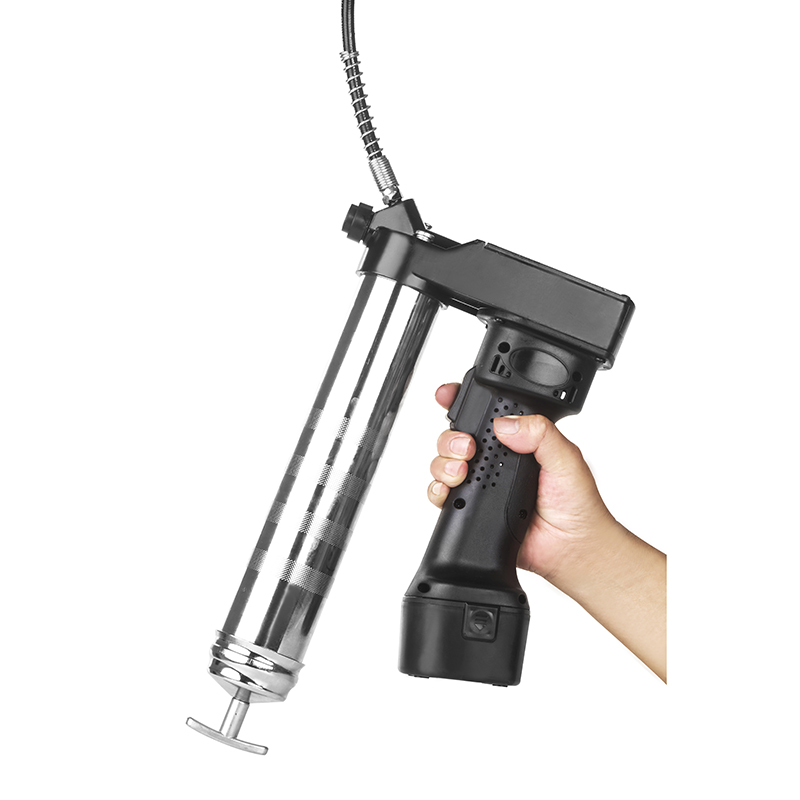
To make an informed purchasing decision, engineers must look beyond the surface. Both tools serve the exact same fundamental purpose—delivering viscous lubricant under high pressure to a specific zerk fitting. Yet, their fluid delivery mechanisms differ entirely.
The manual grease gun has been a reliable staple in workshops for decades. Available primarily in lever-action and pistol-grip configurations, this tool relies strictly on human kinetic force. By aggressively pulling the long lever or squeezing the handle, the user drives an internal piston. This mechanical action builds fluid pressure to force thick grease out of the barrel, through the whip hose, and into the bearing housing. As a result, the dispensed volume depends entirely on the operator's physical stamina and stroke count.
Often referred to as a battery-powered dispenser, this modern alternative replaces human exertion with a high-torque electric motor. Typically powered by robust 12V, 14.4V, or 18V lithium-ion battery platforms, an internal gearbox drives the piston automatically. When the technician pulls the variable-speed trigger, the tool delivers a continuous, steady flow of grease. This removes physical strain from the equation. The mechanic can focus solely on guiding the locking coupler, wiping away abrasive grit, and monitoring the seal purge.
The core debate for maintenance professionals revolves around one critical metric: time. When analyzing which tool genuinely optimizes productivity on the job site, we must break the maintenance process down into measurable field categories.
| Performance Metric | Manual Lever-Action | Cordless Battery-Powered |
|---|---|---|
| Flow Rate | Approx. 1 oz per 30-40 manual pumps | Continuous flow (up to 5-10 oz per minute) |
| Maximum Pressure | 4,000 - 6,000 PSI (Requires high physical effort) | 8,000 - 10,000 PSI (Effortless trigger pull) |
| Operator Fatigue | High (Severe wrist, hand, and forearm strain) | Zero (Motorized pumping mechanism) |
| One-Handed Operation | Extremely difficult (Requires two hands for the lever) | Easy (Frees one hand to secure the hose/coupler) |
| Clearing Clogged Zerks | Slow, physically demanding, often unsuccessful | Instant high-pressure blowout |
Application speed establishes a massive, undeniable lead for the automated option. A standard lever tool requires dozens of exhausting physical pumps to dispense a single ounce of fluid. In stark contrast, an electric model pushes out several ounces per minute continuously. For a single suspension point on a riding mower, this difference is negligible. But for a massive wheel loader with 40 to 50 lubrication points, continuous flow reduces the time spent on each fitting from minutes to mere seconds.
Human fatigue is a hidden metric that drastically slows down maintenance. As a technician's arm tires from repetitive squeezing, the time spent per zerk inevitably increases. Pausing to stretch cramped hands slows the overall workflow. An automated tool eliminates this variable completely. It maintains the exact same speed and pressure from the first fitting of the morning to the hundredth fitting at dusk, ensuring consistent service times.
Fittings frequently become clogged with hardened clay, dried grease, or job-site debris. Clearing a stubborn zerk manually requires immense physical exertion. Mechanics often lean their entire body weight onto the lever to build enough pressure to break the blockage. A high-voltage battery grease gun easily reaches up to 10,000 PSI. This raw power blows through clogged fittings effortlessly, preventing extended delays during routine servicing.
To maintain an objective engineering perspective, we must acknowledge that traditional manual tools still hold significant value in specific scenarios. They are far from obsolete.
No Batteries Required: The tool is always ready for use, regardless of charging infrastructure. It remains highly reliable in remote, off-grid locations like deep forestry sites.
Tactile Feedback: This is a crucial advantage for sensitive machinery. Users can physically "feel" the back-pressure building in the handle. This feedback helps prevent over-greasing, which can blow out delicate rubber seals.
Cost-Effective: The initial acquisition cost is exceptionally low. It serves perfectly as an accessible option for strict budgets or as a foolproof backup tool in the service truck.
Slow Application: The repetitive pumping process is inherently tedious and highly inefficient for large equipment.
Physical Strain: Continuous use leads to forearm fatigue, a frequent complaint noted across industrial maintenance sectors.
Ergonomic Challenges: Lever-action models require two hands to operate effectively, making it incredibly difficult to hold the flexible hose securely onto a hard-to-reach fitting simultaneously.
Upgrading to a battery-powered model represents a fundamental shift toward industrial efficiency. The benefits align directly with reducing machine downtime and maximizing labor output.
Massive Time Savings: Field data indicates that a 45-minute heavy equipment greasing job can often be reduced to a 15-minute task.
One-Handed Operation: Because the internal motor handles the pumping, the operator simply pulls the trigger. This leaves the other hand completely free to stabilize the hose, attach a locking coupler, or wipe away excess purge.
High Pressure & Volume: These tools easily tackle heavy-duty industrial requirements. Thick lubricant reaches deep into massive pins and grooved bushings under high static loads.
Heavier Weight: The copper-wound electric motor and dense lithium battery pack add considerable bulk. Holding the tool overhead underneath a chassis can cause shoulder fatigue.
Battery Management: Requires a disciplined, organized approach to keeping power packs charged and rotated.
Higher Initial Cost: Requires a larger upfront financial investment, which must be justified by usage frequency.
Transitioning to cordless lubrication systems has become a baseline operational standard. However, the final procurement decision often comes down to your specific working environment.
Agriculture & Farming: Agricultural machinery features a massive volume of zerks. Combine harvesters and wide-span implements demand constant upkeep. Farmers consistently report that battery-powered models are absolute lifesavers during tight planting or harvesting windows when every minute of daylight counts.
Construction & Heavy Equipment: Maintaining excavators, bulldozers, and cranes requires a reliable heavy equipment grease gun capable of pushing high volumes of grease into massive pins. The raw PSI of 18V battery models is absolutely non-negotiable in the heavy earth-moving sector.
Industrial & Plant Maintenance: In manufacturing facilities, machine downtime equals lost revenue. Speed and consistency are paramount. Navigating expansive factory floors with hundreds of conveyor bearings makes the automated, rapid flow of an electric model the most logical choice for plant technicians.
Home Mechanics & Occasional DIY: For users who only service a riding lawnmower, a boat trailer axle, or a few suspension components a few times a year, manual tools remain the most sensible and cost-effective choice.
If the evidence points toward upgrading to an automated system, selecting the right specifications is critical. Not all battery-powered options are engineered equally. Let us look at the practical parameters required for professional use.
The primary metric of high-performance equipment is its maximum operating pressure. For standard automotive use, a baseline of 6,000 PSI is generally sufficient. Furthermore, for industrial plant maintenance and heavy construction, an output between 8,000 and 10,000 PSI is the optimal sweet spot. You need this raw force to push fresh lubricant into tight tolerance pins. Look for models delivering continuous flow rates of up to 5 to 10 ounces per minute to transform a grueling routine into a rapid task.
Power delivery dictates performance. Professional-grade tools are typically offered in 12V, 14.4V, and 18V/20V battery configurations. An 18V system provides the maximum torque needed for freezing temperatures and pushing thick NLGI #2 grease. Selecting a model that matches your existing service truck's power tool ecosystem eliminates the need for redundant chargers and reduces initial procurement costs.
Accessibility is a frequent field challenge. Zerks are often recessed deep within engine compartments or located underneath dirty undercarriages. A long, flexible whip hose—ideally measuring 36 to 42 inches—is essential for reaching these obscured points. Additionally, integrated LED work lights illuminate dark cavities. This ensures perfect coupler alignment and prevents messy, high-pressure blow-offs.
For procurement managers and independent contractors, acquiring new equipment must be justified by a measurable Return on Investment (ROI). While manual lever-action guns are incredibly affordable upfront, they hide a substantial hidden cost: labor inefficiency.
Consider a standard daily maintenance routine on a mid-sized excavator featuring approximately 50 grease points. If using a cordless model saves the mechanic just 30 minutes a day compared to manual pumping, that equates to 2.5 hours saved per a standard five-day workweek. If the shop's labor rate is valued at $40 per hour, the tool saves $100 worth of labor every single week. In this highly realistic scenario, a premium automated tool effectively pays for itself in less than a month of deployment.
Beyond direct labor calculations, the most significant financial benefit is increased preventative maintenance compliance. Human nature dictates that highly physically demanding tasks are more likely to be rushed or skipped entirely. When an operator is suffering from arm fatigue, hard-to-reach zerks get ignored. Skipping lubrication leads to accelerated friction and catastrophic bearing failure. By making the greasing process effortless, operators are empirically more likely to execute comprehensive maintenance schedules, saving thousands in unplanned downtime.
Regardless of whether you choose a hand-operated or battery-powered machinery lubrication tool, proper equipment maintenance ensures longevity and prevents cross-contamination of lubricants.
Properly Bleed Air Locks: The most common cause of a tool failing to pump is an air pocket introduced during a cartridge change. Always use the built-in spring-loaded air bleeder valve to release trapped air before attempting to force grease through the hose.
Wipe Down the Coupler and Zerk: Environmental contaminants are the natural enemy of internal bearings. Always use a clean shop rag to wipe the zerk fitting before attaching the coupler. Failing to do so forces abrasive silica sand directly into the bearing housing, accelerating wear.
Battery Storage: Store lithium-ion batteries in a temperature-controlled environment. Leaving them in a freezing service truck makes the grease unpumpably thick and halves battery capacity. Extreme summer heat can degrade the cells permanently.
Upgrade the Coupler: Consider upgrading the standard four-jaw tip to a quick-release locking grease coupler. These aftermarket accessories clamp securely onto the fitting, creating a leak-proof seal and freeing up both hands for safer operation.
Manual models work exceptionally well for small, occasional tasks around the home garage. They are reliable, tactile, and budget-friendly. However, for professional engineering environments, the cordless variant is the undisputed champion. It saves significant time, drastically reduces physical fatigue, and ensures critical machinery is protected without the hassle.
Evaluate your daily workload carefully. If you service more than fifteen zerks a day, the upgrade is not just a convenience—it is a strategic necessity. Ready to optimize your fleet's routine service? Explore professional-grade equipment and find the perfect fit for your operational needs by checking out the high-performance 12V, 14.4V, and 18V solutions at Jinlin Industrial. Upgrade your toolkit today to boost productivity and keep your heavy machinery running flawlessly.
Yes, it is entirely possible. Because electric models build extreme pressure (up to 10,000 PSI) in a fraction of a second, it is much easier to inadvertently over-grease and rupture a rubber bearing seal compared to using a manual lever gun. To prevent this, professional operators rely on the variable speed trigger to slow down the flow rate as the cavity fills. Paying close visual attention to the edges of the seal and stopping the moment old grease begins to purge will protect the integrity of the component.
Battery longevity is highly dependent on the amp-hour (Ah) rating of the battery pack, the ambient temperature, and the viscosity (NLGI grade) of the grease being pumped. As a general industry benchmark, a standard 2.0Ah lithium-ion battery can dispense between 10 and 15 standard 14oz cartridges of grease on a single full charge. Upgrading to a high-capacity 4.0Ah battery can push this number up to 30 or 40 tubes, which is typically more than enough capacity to last an entire week of heavy industrial maintenance.
The better option depends entirely on your operational environment. Pneumatic grease guns are exceptional for stationary, indoor shop environments where a continuous, high-volume air compressor infrastructure is already established. They are lighter than battery models because they lack an onboard motor. However, they are tethered to an air hose, severely limiting their mobility. For field service mechanics, agricultural workers, and heavy construction operators who must maintain equipment outdoors, the cordless battery model provides unmatched, untethered portability.
Maintaining heavy construction and mining equipment requires robust specifications. The industry standard is an 18V or 20V battery-powered model capable of generating a minimum of 8,000 to 10,000 PSI. This high pressure is mandatory for forcing lubricant into tight tolerance pins and bushings under immense static loads. Additionally, the ideal tool should feature a minimum 36-inch flexible whip hose for reaching deep pivot points, an integrated LED work light for dark undercarriages, and a locking coupler to prevent high-pressure blow-offs.
Clearing a blocked zerk requires a systematic approach. First, use a specialized joint unblocker tool filled with penetrating oil; tap it with a hammer to force the solvent into the hardened grease. Let it sit for a few minutes. Next, attach a high-output 10,000 PSI electric grease gun to push through the softened blockage. If the fitting still refuses to accept grease after applying extreme pressure, the internal spring and check ball are likely seized. In this case, simply unthread and replace the zerk fitting entirely.
Most professional electric grease guns are engineered to easily pump standard multi-purpose NLGI #2 lithium complex grease, which is the industry standard for automotive and heavy equipment. However, in extreme winter conditions where temperatures drop below freezing, NLGI #2 becomes excessively thick. Switching to a lower viscosity NLGI #1 or #0 synthetic grease during winter months prevents the tool's internal electric motor from overloading and ensures a smooth, continuous flow rate.


