+86-25-8470-5507


Views: 0 Author: Site Editor Publish Time: 2026-09-07 Origin: Site


Picture a familiar workshop scenario. You are under the hood, wrestling with an awkward five-gallon drum of expensive 0W-20 synthetic oil. Attempting to pour it directly into a tiny, obstructed engine filler hole without the proper tools almost always ends in disaster. Spilled oil coats the hot exhaust manifold, creating foul-smelling smoke and a severe slip hazard on the concrete floor. Even worse, the engine crankcase ends up either underfilled or dangerously overfilled.
Inaccurate fluid measurement is far more than just a minor inconvenience; it is a serious mechanical liability. Modern internal combustion engines are engineered with incredibly tight tolerances. Pouring an extra half-liter of oil can cause the crankshaft to submerge in the oil pan. This whips the fluid into a frothy foam, drastically reducing hydraulic pressure and starving vital bearings. Conversely, relying on poorly marked containers or repurposed household plastics introduces a high risk of chemical leaching and fluid contamination.
The most effective solution to this widespread problem is investing in dedicated, professional-grade equipment. Serving as a critical workshop tool, a high-quality measuring oil can provides the exact accuracy and cleanliness required for modern vehicle maintenance. This comprehensive guide will help professional mechanics and serious DIY enthusiasts choose the exact size—ranging from 1L to 8L—and the specific features needed for various automotive fluids, ensuring a clean, accurate, and highly efficient workflow.
Size Matters: Match the jug capacity directly to the job at hand. Use 1L to 2L jugs for small engines and precise top-ups, 3L to 5L jugs for standard passenger car oil changes, and 6L to 8L jugs for heavy-duty trucks and large-capacity cooling systems.
Material is Crucial: Always prioritize corrosion-resistant, automotive-grade plastics (like translucent High-Density Polyethylene or HDPE) to withstand harsh chemicals without degrading.
Design Features Ensure Accuracy: Seek out jugs equipped with deeply embossed metric/imperial scales, flexible spouts for hard-to-reach fill holes, and hinged lids to prevent environmental contamination.
Dedicated Jugs Prevent Damage: Avoid catastrophic cross-contamination by utilizing completely separate, clearly labeled containers for motor oil, engine coolant, and gear fluids.
It is a common temptation for entry-level DIYers to repurpose kitchen measuring cups or reuse old water bottles for fluid transfers. However, in a professional shop or a serious home garage setting, these makeshift solutions fall drastically short. Standard household plastics simply are not engineered to withstand the highly aggressive nature of petroleum-based products, brake fluids, or chemical degreasers. Over time, they will warp, become brittle, or leach chemical impurities directly into your fresh fluids.
Beyond material integrity, mechanical accuracy is paramount. Specific fluid capacity requirements dictate the lifespan of engine components. A dedicated measuring tool eliminates guesswork, ensuring you meet exact manufacturer specifications every single time. Furthermore, cleanliness and safety heavily dictate the need for proper equipment. A well-designed jug features an engineered spout that controls fluid flow, significantly reducing accidental spills. Keeping the workspace safe from dangerous slip hazards while protecting the environment from chemical runoff must be a priority for any responsible technician.
Specifically, time efficiency is vastly improved when using the right tools. Dispensing the exact required amount of fluid in a single trip from the bulk drum to the vehicle drastically speeds up routine maintenance tasks. For independent repair shops, this directly translates to increased vehicle throughput and higher daily profitability.
The automotive maintenance industry is currently experiencing a significant shift towards high-precision, eco-conscious fluid management. As vehicle engineering advances, the rising costs of premium, application-specific synthetic oils and advanced coolants have made fluid waste a highly expensive operational issue. Mechanics can no longer afford to "eyeball" fluid levels or lose expensive synthetic lubricants to messy bench spills.
Moreover, the rise of electric vehicles (EVs) and complex hybrid systems has introduced a need for exact measurements of specialized dielectric cooling fluids and reduction gear oils. Stricter environmental regulations regarding the disposal and handling of hazardous workshop fluids are also pushing garages to adopt closed-loop dispensing systems alongside highly accurate measuring tools. The demand for durable, reusable, and chemically inert measuring jugs has surged as modern workshops aim to reduce their reliance on single-use plastic quart bottles. This transition not only minimizes the shop's carbon footprint but directly aligns with the modern standard of precise, zero-waste vehicle servicing.
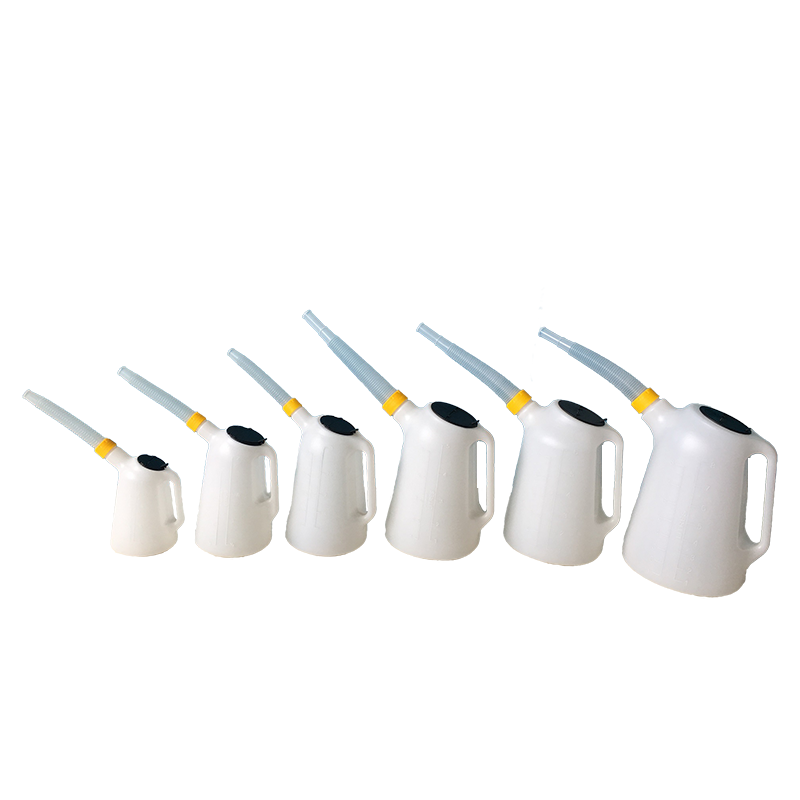
Selecting the correct capacity is the most critical decision when purchasing fluid measurement tools. A jug that is too large becomes physically awkward for small, delicate jobs. In contrast, a jug that is too small requires multiple trips, increasing the margin of error and the risk of spilling. Here is a detailed engineering breakdown of how to match the container size to your specific mechanical applications.
Best for: Motorcycles, ATVs, lawnmowers, small power equipment, and the precise measuring of specialty oil additives or friction modifiers.
Advantages: At this capacity, the jugs are exceptionally lightweight and easy to maneuver in tight, restricted spaces, such as between motorcycle fairings or compact tractor frames. The graduations on a 1L or 2L jug are typically marked in much smaller increments (often down to 50ml or 100ml intervals). This allows for the micro-precision required when mixing two-stroke oils or adding specific ratios of limited-slip differential modifiers, where a variance of just a few ounces can alter the chemical balance of the entire mechanical system.
Best for: Most standard passenger cars, mid-size sedans, and light-duty crossover SUVs.
Advantages: This size range represents the ultimate "sweet spot" for the vast majority of DIY mechanics and independent repair shops. A typical four-cylinder or six-cylinder passenger vehicle requires between 4.2 to 5.0 liters of engine oil. A 5L jug allows the mechanic to measure and pour the entire fluid capacity in a single, continuous motion. It provides the perfect balance between holding sufficient volume and remaining ergonomically manageable when full, preventing wrist strain during the pour.
Best for: Heavy-duty diesel pickup trucks, commercial fleet vehicles, agricultural tractors, and performing full system flushes.
Advantages: Diesel engines frequently require 10 to 15 liters of oil. Using a small container for this task is highly inefficient and frustrating. The 6L to 8L size minimizes trips to the bulk oil dispenser. Additionally, these larger sizes serve perfectly as a dedicated coolant measuring jug, since automotive cooling systems frequently hold 7 to 12 liters of antifreeze. When purchasing jugs in this weight class, it is imperative to look for reinforced, ergonomic handles; eight liters of fluid weighs approximately 16 to 18 pounds, requiring a sturdy grip for a controlled pour.
Not all fluid containers are manufactured to the same engineering standard. When evaluating tools for a professional environment, specific structural and design features dictate the longevity and reliability of the product. Purchasing based on material quality rather than just price will save you from frustrating leaks and inaccurate measurements down the road.
The chemical composition of the jug is the first line of defense against degradation. Workshop tools are regularly exposed to aggressive solvents, including synthetic motor oils, ethylene glycol, DOT 3/4 brake fluids, and highly corrosive gear lubricants. Translucent High-Density Polyethylene (HDPE) is the absolute industry standard. HDPE offers exceptional chemical resistance, high impact strength, and excellent temperature tolerance. The translucency is vital, allowing technicians to visually verify fluid levels against the external scale instantly.
A measuring tool is completely useless if you cannot confidently read the measurements. Many low-cost containers feature painted or printed scales on the exterior. Over time, exposure to degreasers, brake cleaner, and simple mechanical abrasion will erase these markings. A professional-grade graduated oil jug must feature embossed (raised) or deeply engraved markings molded directly into the plastic. It should also display dual metrics—both Liters and Quarts—to accommodate service manuals from different international automotive manufacturers without requiring complex mental math.
The geometry of the engine bay dictates the type of spout required for a clean fill. Flexible or gooseneck spouts are essential for modern, tightly packed engine bays where the oil fill port is obstructed by intake manifolds or plastic cowling. A high-quality flexible spout allows the mechanic to snake the nozzle directly into the port, eliminating the need for a separate funnel.
Equally important is contamination prevention. Workshops are inherently dusty environments, filled with airborne particulates from grinding and sanding. Introducing particulate matter into an engine's crankcase can score cylinder walls and destroy delicate bearings. Premium models now feature a hinged lid design and tethered dust caps for the spout, ensuring the interior remains clinically clean between uses.
One of the most catastrophic errors in automotive maintenance is fluid cross-contamination. Workshop fluids are chemically distinct and highly reactive to one another. Taking shortcuts here can result in thousands of dollars in mechanical damage.
If a jug used for antifreeze is subsequently used for motor oil without proper sterilization, trace amounts of ethylene glycol will enter the engine block. Glycol reacts with motor oil under heat to form a thick, abrasive sludge that blocks oil galleys and rapidly destroys engine bearings. Similarly, introducing petroleum-based oil residue into a brake fluid reservoir will cause the rubber seals in the braking system to swell and fail, resulting in a complete and sudden loss of braking power.
To mitigate this risk entirely, professional garages employ strict separation protocols. The most effective method is a labeling and color-coding strategy. Dedicate a specific fluid dispensing jug for each chemical type. For instance, assign clear/white jugs exclusively to engine motor oil, blue jugs to coolant, and red jugs to transmission fluids. Do not rely on memory; use a chemical-resistant paint pen to permanently mark the side of every container (e.g., "COOLANT ONLY").
The accuracy and lifespan of your measuring tools depend heavily on post-use maintenance. Residual fluids left in a jug will oxidize, attract dust, and eventually form a sticky residue that obscures measurement lines and contaminates future fluid fills.
Never leave fluids sitting in a jug overnight. Immediately after use, invert the workshop measuring jug and store it upside down on a dedicated, sloped drip tray. Gravity is the most effective initial cleaning tool, and allowing it to drain while the oil is still warm prevents a film from building up on the interior walls.
To remove stubborn oil films, use a non-chlorinated brake cleaner or a citrus-based industrial degreaser sparingly. Spray a small amount into the jug, swirl it to break down the oil, and wipe it completely dry with a lint-free shop towel. Avoid using highly abrasive brushes, as scratching the interior plastic creates micro-grooves where future contaminants can hide.
Automotive service manuals vary wildly depending on the vehicle's country of origin. A domestic truck manual will list capacities in Quarts or Gallons, while a European or Japanese manual will strictly use Liters and Milliliters. Having a reliable conversion reference ensures you can accurately utilize your measurement tools regardless of the vehicle's origin.
| Metric Volume (Liters / ml) | US Imperial Equivalent (Quarts / Gallons) | US Fluid Ounces (fl oz) |
|---|---|---|
| 500 ml (0.5 L) | 0.52 Quarts | 16.9 fl oz |
| 1 Liter (1000 ml) | 1.05 Quarts | 33.8 fl oz |
| 2 Liters | 2.11 Quarts | 67.6 fl oz |
| 3 Liters | 3.17 Quarts | 101.4 fl oz |
| 3.78 Liters | 1.0 Gallon (4.0 Quarts) | 128.0 fl oz |
| 4 Liters | 4.22 Quarts | 135.2 fl oz |
| 5 Liters | 5.28 Quarts | 169.0 fl oz |
| 6 Liters | 6.34 Quarts | 202.8 fl oz |
| 8 Liters | 8.45 Quarts (2.11 Gallons) | 270.5 fl oz |
Practical Application Tip: For quick mental math on the shop floor, remember that 1 Liter is roughly equal to 1 Quart. While not perfectly exact, treating them as equal is generally safe for minor fluid top-ups. However, when a manual calls for a dry-fill engine rebuild, always utilize the exact conversion ratios to prevent overfilling.
Choosing the right fluid measurement tools fundamentally improves your workshop workflow. By matching the container capacity directly to your typical vehicle needs—whether that is a precise 1L top-up on a motorcycle or an 8L heavy-duty diesel flush—you eliminate guesswork and frustrating spills entirely.
Always select materials engineered to handle harsh workshop chemicals. Prioritize translucent HDPE bodies, clear embossed graduations, and hinged lids for ultimate dust protection. A 5L jug remains the ideal starting point for most home garages, while professional shops will benefit immensely from keeping a full suite of 1L, 2L, 3L, 4L, 5L, 6L, and 8L sizes on hand.
Upgrade your workspace today by investing in reliable, durable fluid dispensing tools. For professional-grade solutions, explore the comprehensive range of oil measuring jugs with hinged lids available at Jinlin Industry (https://www.jinlin-ind.com). A clean, accurate pour not only protects your engine components but also elevates the overall professionalism of your automotive maintenance.
No. Kitchen plastics are not designed to withstand corrosive automotive chemicals. When exposed to motor oil, brake fluid, or strong degreasers, household plastics may melt, warp, or leach chemical impurities directly into the fresh fluid. Always use a dedicated, automotive-grade HDPE measuring jug to ensure safety and fluid integrity.
A 5L (or 5-quart) jug is the ideal size for standard automotive work. Most modern 4-cylinder and standard 6-cylinder passenger car engines require between 4 to 5 liters of oil. This size allows you to complete the entire fill process in one single, convenient pour without the jug being too heavy to handle comfortably.
It is highly discouraged. Even microscopic trace amounts of motor oil inside your cooling system (or vice versa) can cause severe engine issues. When oil and coolant mix, they create a thick sludge that degrades internal seals and blocks fluid galleys. Always purchase and clearly label a separate jug specifically for coolant.
To get an exact measurement, place the jug on a perfectly level surface. Look at the fluid from eye level. You will notice the liquid forms a slight curve at the top, known as the meniscus. Always read the measurement at the bottom (the lowest point) of that curve against the embossed scale on the jug.
While HDPE jugs are chemically resistant, they are not designed for long-term storage. Measuring jugs typically lack airtight seals, meaning the oil can oxidize over time and absorb moisture from the air, degrading its lubricating properties. Always pour leftover oil back into its original sealed container for storage.


