+86-25-8470-5507


Views: 0 Author: Site Editor Publish Time: 2026-09-11 Origin: Site


Wiping up a slick puddle of 5W-30 from your garage floor is frustrating. But watching expensive synthetic fluid drip down a hot exhaust manifold? That is a recipe for noxious smoke and potential component damage. Modern vehicle engine bays are incredibly cramped. Automotive manufacturers pack complex intake manifolds, bulky turbochargers, and dense wiring harnesses into every available inch of space. Consequently, standard fluid transfer tools simply cannot reach recessed fill ports.
This structural limitation causes messy, dangerous, and wasteful spills during routine maintenance. Relying on gravity and a steady hand? That no longer cuts it. In this comprehensive guide, we will explore a vastly superior method for fluid management from a professional engineering perspective. You will discover exactly how a modular funnel system works, step-by-step techniques for mess-free transfers, and the exact specifications to look for when upgrading your shop equipment.
Before diving into the fluid dynamics of automotive maintenance, here is a quick overview of why upgrading your equipment is a logical decision for long-term reliability:
Eliminates Mess: Creates a mechanical, sealed connection to the reservoir. This prevents overflow and hazardous shop floor puddles.
Unmatched Reach: Navigates seamlessly around intake manifolds and drive belts to access hidden dipstick tubes.
Essential for Thermal Management: Acts as an elevated expansion tank. It remains the most effective way to safely bleed air out of a radiator.
Versatile Application: Functions flawlessly across multiple tasks, from heavy gear oil top-offs to windshield washer fluid refills.
Universal Fit: Premium kits include threaded and bayonet-style adapters to lock onto virtually any passenger vehicle.
Automotive maintenance demands precision. To understand the true commercial value of a specialized transfer system, we must examine the physical limitations of traditional plastic cones. How do modern engineered solutions address these exact failure points?
Traditional funnels feature a basic, rigid conical design. While somewhat functional for open-air applications—like filling a lawnmower—they present significant mechanical disadvantages under a car hood. First, they lack physical stability. A standard funnel rests loosely. It relies entirely on the friction between its narrow spout and the vehicle’s fill port. Because the center of gravity shifts upward as you pour heavy liquids, the entire setup becomes highly susceptible to tipping.
Furthermore, standard designs suffer from poor aerodynamics. When liquid enters a closed reservoir, the existing air must escape. If the spout blocks the entire hole, escaping air is forced upward through the incoming liquid. This creates a violent "glugging" effect. Splashed coolant or oil coats sensitive electrical sensors and serpentine belts. Ultimately, this leads to accelerated wear and foul odors burning off the engine block.
A purpose-built automotive fluid funnel is engineered to solve these exact structural issues. It is not merely a piece of molded plastic. Rather, it is a modular system designed for secure, hands-free operation.
| Feature | Standard Plastic Funnel | Engineered Spill-Proof System |
|---|---|---|
| Connection Stability | Loose friction fit; prone to tipping | Threaded/Bayonet locking adapters; hands-free |
| Fluid Control | None; relies on user precision | Internal fluid stopper (plunger) prevents overflow |
| Air Bleeding | Causes violent splashing ("glugging") | Vented design allows seamless air escape |
| Accessibility | Straight rigid spout; blocked by engine covers | Articulated extensions; reaches hidden ports easily |
Direct-Fit Adapters: The foundation of this system is the adapter kit. Instead of resting loosely in a hole, the kit utilizes color-coded, threaded adapters that lock directly into the radiator neck or engine block. Listen for the satisfying click or tight rotation of the cap locking into place. This creates a hermetic seal, transforming the funnel into a temporary extension of the engine itself.
The Fluid Stopper (Plunger): One of the most critical engineering additions is the internal fluid stopper. This long rod features a tapered rubber plug at the base. If you accidentally pour too much, you simply insert the stopper into the center hole. It halts the flow instantly. You can then move the unit without a single drop escaping.
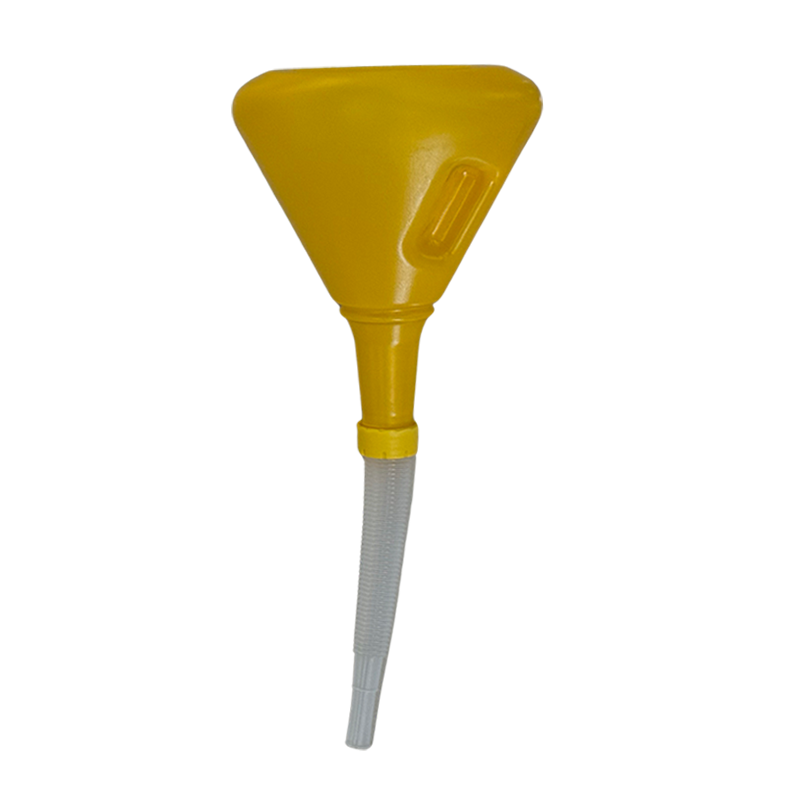
The modular nature of these tool kits makes them highly versatile. Different automotive fluids possess distinct viscosities and chemical compositions, requiring careful, specific handling.
Particularly in colder climates, motor oil has a high viscosity. Pouring thick 15W-40 from a heavy 5-quart jug requires two hands for stability. When utilizing an oil transfer funnel equipped with a locking adapter, the tool remains rigidly fixed to the valve cover. The technician can comfortably use both hands to control the heavy jug, ensuring a smooth, controlled pour. The wide basin easily accommodates the slow flow rate of cold oil without backing up and overflowing.
Engine antifreeze is a highly hazardous chemical. Ethylene glycol is toxic to humans, pets, and the local groundwater supply. Spilling it on a hot exhaust creates thick, toxic vapor. The sealed connection of a specialized kit ensures that as the cooling system pressurizes during a flush, the toxic liquid remains safely contained within the basin rather than cascading onto the garage floor.
Unlike oil caps located conveniently at the top of the engine, transmission dipstick tubes are notoriously difficult to access. They are often buried deep near the firewall. Standard cones simply cannot reach these points. By attaching a flexible extension, the user can snake the spout down through the mechanical maze, establishing a secure connection to the recessed tube. Overfilling transmission fluid onto a hot exhaust pipe presents a severe fire hazard, making this precision absolutely vital.
Proper execution is key to maintaining a pristine workspace. Utilizing a flexible spout funnel correctly requires following a systematic process to guarantee a secure seal.
Step 1: Select the Right Adapter
Begin by identifying the target port. Select the corresponding threaded or bayonet adapter from your kit. Test-fit the adapter onto the reservoir without the basin attached. It should thread on smoothly without cross-threading and lock firmly into place.
Step 2: Attach the Flexible Spout (If Necessary)
Evaluate the clearance above the port. If a straight vertical pour is obstructed by the hood latch or engine covers, attach the articulated extension to the base. Ensure the joint is fully seated to prevent seepage.
Step 3: Secure the Funnel Assembly
Press the main basin firmly into the locked adapter. Most high-quality kits use a tight friction-fit or a twist-lock mechanism. Once seated, give it a gentle tug to verify mechanical stability.
Step 4: Pour Slowly and Monitor
Hold the jug sideways (with the spout at the top) to allow air to enter the container. This prevents the liquid from surging. Pour at a moderate pace. Keep a close eye on the transparent basin, allowing time for thick fluids like gear oil to travel down the narrow spout.
Step 5: Engage the Fluid Stopper
This is the most crucial step for preventing a mess. If the reservoir is full but residual liquid remains in the basin, do not attempt to lift it. Instead, push the plunger stick firmly into the center drain hole. This rubber stopper creates a watertight seal. You can now detach the entire assembly and transfer the remaining liquid back into its original container safely.
One of the most complex routine maintenance tasks is servicing a vehicle's cooling system. While draining old antifreeze is straightforward, refilling the system presents a unique thermodynamic challenge.
A vehicle’s cooling loop is designed to circulate liquid to dissipate heat. When you drain it, ambient air enters the empty passages. Pouring new antifreeze back in traps this air behind the thermostat and inside the complex water jackets of the engine block. If these air pockets are not bled out, they cause the water pump to cavitate (spin without moving liquid). This inevitably leads to rapid, catastrophic engine overheating.
Recent automotive industry analyses highlight a massive shift toward highly complex thermal management systems. With the rapid adoption of hybrid and electric vehicles (EVs), modern cooling networks now feature multiple independent loops, battery chillers, and intricate pathways. These systems are notoriously difficult to bleed manually. Consequently, professional technicians are moving away from traditional open-pour methods. There is a growing industry consensus that utilizing specialized, sealed fluid management tools is mandatory to prevent catastrophic airlocks in modern EV and ICE architectures.
Attempting to bleed a radiator without a sealed system is highly problematic. As the engine warms up, trapped air violently forces its way to the top, pushing boiling liquid out of the open neck. By attaching the sealed adapter and filling the basin one-third full, you effectively raise the highest point of the cooling system.
As the engine idles and the thermostat opens, trapped air bubbles are forced through the system. Because air is lighter than liquid, the bubbles travel up the neck and harmlessly exit through the fluid inside the basin. Simultaneously, gravity instantly pulls an equal volume of liquid down to fill the void. This continuous exchange happens safely contained within the transparent walls.
Investing in specialized garage tools requires evaluating specific engineering parameters and material quality. Purchasing a complete, well-designed spill free funnel system is far more cost-effective than buying individual, mismatched components. Here is what you should look for based on professional OEM specifications.
Comprehensive 15-Piece Adapter Sets: Automotive manufacturers do not use a standardized thread pitch for their filler necks. European vehicles often utilize specific threaded caps, while Asian and domestic vehicles rely on quarter-turn bayonet styles. A premium kit should feature multiple color-coded adapters (e.g., specific fittings for Ford, GM, Toyota, and Honda). Without the correct adapter, you cannot form a hermetic seal.
High-Quality, Transparent Material: Engine coolant can easily exceed 220°F (105°C) during the bleeding process. Therefore, the construction material must be heavy-duty, heat-resistant polymers like High-Density Polyethylene (HDPE). Furthermore, look for a 5-inch transparent basin. Transparency is a critical functional requirement, allowing the user to visually monitor fluid levels in real-time and observe escaping air bubbles.
A Reliable Fluid Stopper: The mechanism that truly defines this tool is the central plunger. Ensure the stopper fits snugly and utilizes a durable, chemical-resistant rubber seal (such as Viton or Nitrile) that will not shrink, swell, or crack after repeated exposure to harsh hydrocarbons.
Included Extensions: A standard straight cone is frequently useless in densely packed modern engine compartments. Look for kits that provide a 45-degree elbow joint, a 5-inch straight extension pipe, and a high-quality articulated hose attachment to bypass structural obstructions seamlessly.
Acquiring a high-quality tool is only the first step. Automotive fluids are highly specialized, and cross-contaminating them can lead to severe mechanical failures.
One of the most severe mistakes a mechanic can make is using the same unwashed basin for different chemical families. Antifreeze is water-based, while motor oil is a hydrocarbon lubricant. Mixing residual coolant with fresh oil creates a thick, milky sludge that clogs internal engine galleys. Introducing even trace amounts of engine oil into an automatic transmission can degrade the friction modifiers, potentially destroying the clutch packs.
To mitigate this risk, strict protocols must be followed. Many professionals purchase two separate kits: one dedicated exclusively to water-based liquids and another reserved strictly for petroleum-based lubricants. If utilizing a single workshop funnel, rigorous cleaning between every single use is absolutely mandatory.
Proper cleaning preserves the integrity of the plastic and rubber seals. Leaving sticky residue attracts dust and metallic shavings, which will then be flushed directly into your engine during the next use.
After draining completely, use a mild degreaser or dedicated brake parts cleaner to break down hydrocarbon residue. For antifreeze, warm water and dish soap are highly effective. Wipe the interior completely dry with lint-free microfiber cloths. Finally, inspect the rubber O-rings on the adapters. If they appear dry, apply a very light coating of silicone paste to prevent dry rotting, and store the entire kit in a sealed, climate-controlled case away from degrading UV sunlight.
A specialized, sealed fluid management system is not just a luxury; it is a practical necessity for routine vehicle maintenance. It effectively prevents hazardous spills, protects sensitive engine bay components, and saves valuable cleanup time during complex transfers. Whether you are executing a simple synthetic oil change or tackling a highly technical radiator flush, upgrading your garage toolkit with reliable, modular equipment ensures the job is done safely, cleanly, and professionally.
Ready to upgrade your shop equipment and eliminate fluid spills for good? Evaluate your specific maintenance needs and choose a professional-grade fluid management system that fits your requirements. Explore the comprehensive range of engineered funnel kits and automotive tools at Jinlin Industrial (jinlin-ind.com) to find the perfect match for your garage today.
While it is mechanically possible to bleed a cooling system without one, it is highly discouraged. As an engine reaches operating temperature, the liquid undergoes thermal expansion, and trapped air pockets are violently forced out. Without a sealed basin acting as a temporary, elevated expansion tank, the boiling liquid will overflow the neck, causing a toxic and dangerous spill in your workspace.
Yes, provided it is a premium unit. High-quality kits are manufactured from heavy-duty, heat-resistant plastics specifically engineered to withstand the extreme temperatures of hot oil and boiling antifreeze. However, operators must always exercise extreme caution. Never attempt to attach adapters or open a radiator cap while the system is fully pressurized and hot, as this can result in severe scalding.
In the context of automotive tools, "universal" generally means the kit covers approximately 90% to 95% of common passenger vehicles on the road today. Most comprehensive kits include a wide variety of adapters designed to fit domestic, Asian, and European makes. Heavy-duty commercial trucks or vintage vehicles with non-standard reservoirs may still require proprietary adapters.
This is achieved through the integrated plunger mechanism. Once the vehicle's reservoir is full, simply insert the provided stopper stick into the center drain hole at the bottom of the basin. The rubber O-ring creates a tight mechanical seal. With the hole plugged, you can safely unlock the assembly and carry it to your recycling jug without a single drop escaping.
Mechanically, yes, but chemically, it is highly discouraged unless meticulously cleaned. Oil is petroleum-based, while coolant is water-based. Mixing the two creates a damaging sludge. Professional engineers recommend maintaining two separate funnel kits to completely eliminate the risk of cross-contamination.
Leaks at the base usually occur for two reasons: either the wrong adapter was selected, resulting in mismatched threads, or the internal rubber O-ring on the adapter is damaged or missing. Always verify you have selected the correct color-coded adapter for your specific vehicle make, and regularly inspect the O-rings for signs of dry rotting.


