+86-25-8470-5507


Views: 0 Author: Site Editor Publish Time: 2026-08-02 Origin: Site


Moving raw materials into mixers and reactors introduces significant operational risks if you use the wrong transfer equipment. Improper selection routinely causes powder bridging, liquid retention, and cross-contamination. These issues lead to failed swab tests and non-compliance with FDA or GMP standards. When you handle active pharmaceutical ingredients or sensitive food products, a minor transfer bottleneck compromises the entire production run.
This technical evaluation guide helps process engineers and operations managers specify the correct industrial and laboratory transfer equipment. We cover material compatibility, geometric design, and regulatory requirements. You will learn how to eliminate dead legs, ensure seamless cleanability, and optimize liquid and bulk solid workflows. Properly engineered transfer solutions protect product yield and guarantee compliance on the manufacturing floor.
Material Compatibility Dictates Safety: Selecting between 316L stainless steel and specific polymers depends entirely on the chemical aggressiveness and temperature of the transferred media.
Compliance is Non-Negotiable: A true food grade funnel or pharma-grade funnel requires verifiable documentation, including Material Test Reports (MTRs) and FDA/USP Class VI certifications.
Design Impacts Cleanability: Sanitary connections (like Tri-Clamps) and specific surface finish roughness (Ra) are mandatory for effective Clean-In-Place (CIP) and Steam-In-Place (SIP) processes.
Powder vs. Liquid Dynamics Require Different Geometries: Viscosity and powder flowability dictate the required cone angle and discharge diameter to prevent bottlenecking and yield loss.
Scale Dictates Function: Process-scale operations rely on heavy-duty sanitary transfer hoppers, while quality control (QC) and R&D laboratories utilize specialized filtration and separation funnels.
Liquid transfer requires precise control over fluid dynamics to maintain product quality. You must minimize splashing, prevent aeration, and ensure complete drainage without pooling. Splashing creates secondary contamination risks on surrounding equipment surfaces. Aeration introduces unwanted oxygen into sensitive food or pharmaceutical mixtures, which accelerates oxidation or alters the specific gravity of the batch. Complete drainage ensures accurate dosing and prevents residual liquid from harboring microbial growth between cycles.
Powder and bulk solid transfer presents entirely different mechanical challenges. Success depends on achieving consistent mass flow, preventing rat-holing or bridging, and managing dust generation. Bridging occurs when cohesive powders form an arch over the discharge opening, halting production. Rat-holing happens when only the central column of powder flows, leaving stagnant material on the vessel walls. Dust generation poses respiratory hazards to operators and creates explosive atmospheres if not properly contained.
Equipment geometry must match the specific rheology of the product. Highly viscous liquids require steeper cone angles and larger discharge diameters to maintain acceptable flow rates. Cohesive powders often necessitate asymmetrical cones. An asymmetrical design features one straight wall, which disrupts the structural integrity of powder arches and promotes reliable mass flow. Steep discharge angles reduce the friction between the material and the equipment wall, preventing bottlenecking and subsequent yield loss.
| Transfer Type | Primary Challenge | Geometric Solution | Success Criteria |
|---|---|---|---|
| Liquid | Pooling and Aeration | Symmetrical, steep angles with smooth transitions | Complete drainage, zero splashing |
| Cohesive Powder | Bridging and Rat-holing | Asymmetrical cones, offset discharge | Consistent mass flow, zero arching |
| Free-Flowing Solid | Dust Generation | Standard 60-degree cones with dust extraction ports | Contained transfer, minimal airborne particulates |
Analytical and membrane filtration processes rely heavily on specialized laboratory equipment. Technicians use Büchner and Hirsch designs equipped with filter paper or fritted glass discs for pharmaceutical precipitate collection, clarification, and purification. These vacuum-assisted devices allow for rapid separation of solid particulates from liquid solvents. The precision of the fritted disc dictates the micron rating of the filtration, ensuring absolute clarity in quality control samples before they undergo high-performance liquid chromatography (HPLC) testing.
Liquid-liquid extraction represents another core laboratory application. Separatory devices isolate specific compounds based on their varying solubilities in immiscible solvents. In food chemistry, technicians use these tools to extract essential oils, lipids, and flavor compounds from raw materials. Pharmaceutical drug synthesis relies on solvent phase separation to isolate active pharmaceutical ingredients from reaction byproducts. The precise stopcock control allows operators to drain the heavier phase with exact precision, ensuring high-purity extraction.
Microbiological and bioburden testing mandates strict sterile protocols. Vacuum-assisted micro-filtration units test water purity and monitor microbial contamination in sterile processing environments. Technicians pass specific volumes of process water through a membrane filter, which captures any present microorganisms. The membrane is then incubated to quantify the bioburden. These testing units must be inherently sterile and easily disposable or fully autoclavable to prevent false-positive results during environmental monitoring.
Batch-to-batch contamination carries severe financial and regulatory consequences. A single failed swab test forces the quarantine and destruction of millions of dollars of pharmaceutical product. Regulatory agencies like the FDA issue warning letters and halt production if facilities cannot prove their cleaning validation protocols are effective. Yield loss from retained material directly impacts the bottom line, especially when processing high-value active pharmaceutical ingredients where every gram holds significant monetary value.
Seamless construction directly reduces microbial harboring points. Traditional fabrication methods often leave microscopic crevices at weld seams or joints. These dead legs trap product residue and resist standard cleaning chemicals. Specifying equipment machined from solid billets or utilizing fully penetrated, ground, and polished welds eliminates these risks. Removing dead legs ensures that cleaning solutions make direct, turbulent contact with all internal surfaces, guaranteeing a fully sanitized environment for the next production batch.
Stainless steel remains the default material for industrial sanitary processing. 304 stainless steel serves as the standard for general food processing applications. It offers excellent corrosion resistance against water, organic chemicals, and a wide variety of inorganic chemicals. Facilities commonly specify 304 for dry ingredient handling, dairy processing, and brewing operations where the chemical environment remains relatively mild and predictable.
316L stainless steel represents the industry standard for pharmaceutical manufacturing and highly corrosive food environments. The "L" denotes a lower carbon content, which minimizes carbide precipitation during welding and maintains superior corrosion resistance at the seams. The addition of molybdenum significantly enhances pitting resistance against chlorides and harsh cleaning agents used in rigorous sanitation protocols. When processing acidic foods like tomato paste or handling aggressive pharmaceutical solvents, 316L provides the necessary metallurgical stability.
Borosilicate 3.3 glass dominates laboratory environments due to its exceptional thermal shock resistance and chemical inertness. It withstands rapid temperature changes without fracturing, making it ideal for exothermic reactions or hot solvent filtrations. Borosilicate glass remains completely unreactive in the presence of strong acids and alkalis, ensuring that no metallic ions leach into sensitive analytical samples. Its transparency also allows technicians to visually monitor phase separations and filtration progress in real-time.
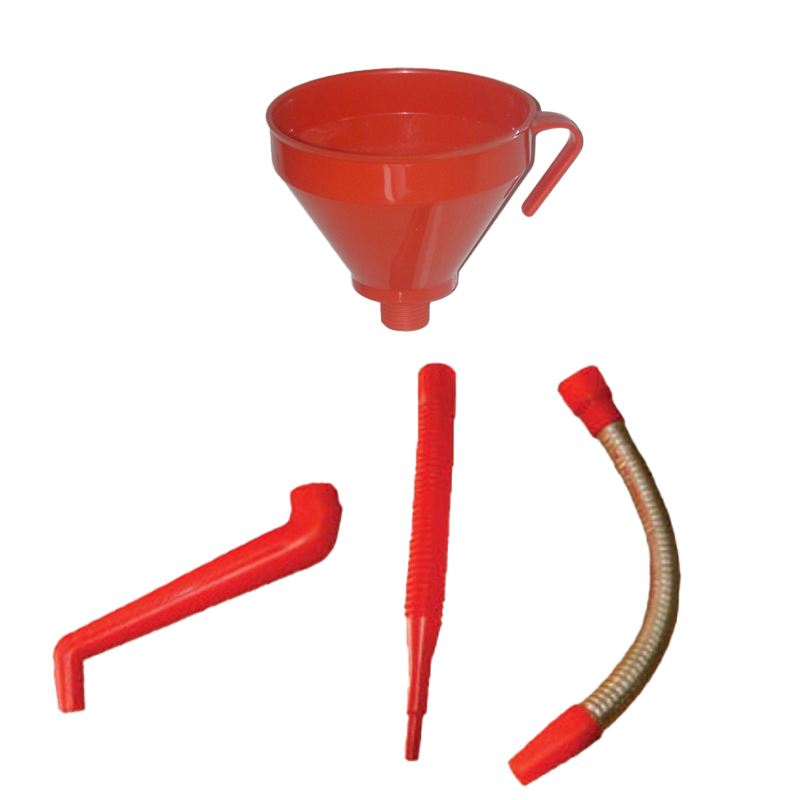
High-performance polymers serve applications requiring chemical inertness, non-metallic contact, or shatterproof properties on the production floor. Polypropylene offers excellent durability and chemical resistance for general-purpose transfers. PTFE and PFA provide near-universal chemical compatibility and extreme temperature resistance, ideal for highly aggressive pharmaceutical intermediates. HDPE provides a rugged, cost-effective solution for bulk powder handling. When specifying a Food Grade Funnel made of plastic, the material must strictly lack BPA, phthalates, and reactive plasticizers to prevent chemical leaching into the food supply.
Surface roughness dictates the cleanability of any product-contact surface. Engineers measure this roughness using the Ra (Roughness Average) scale. Pharmaceutical applications typically require an Ra of less than 15 microinches (0.38 micrometers). At this microscopic level, the surface lacks the peaks and valleys where bacteria can adhere and multiply. Achieving this specification requires precise finishing techniques that go beyond standard fabrication practices.
Mechanical polishing uses abrasives to physically smooth the metal, but it leaves microscopic directional scratches. Passivation is a chemical treatment using nitric or citric acid that removes free iron from the surface, enhancing the protective chromium oxide layer. Electropolishing provides the ultimate sanitary finish. This electrochemical process removes a uniform layer of surface metal, dissolving the microscopic peaks and leaving a highly reflective, ultra-smooth surface. Electropolished surfaces drastically reduce product adhesion and maximize the efficacy of automated cleaning cycles.
Equipment used in food manufacturing must comply with strict federal guidelines. FDA 21 CFR Part 177 dictates the specific polymers and additives legally permitted for direct food contact. It ensures that plastics will not degrade or leach harmful compounds under normal processing conditions. Furthermore, FDA 21 CFR Part 110 outlines the Current Good Manufacturing Practice (cGMP) in Manufacturing, Packing, or Holding Human Food. This regulation mandates that all equipment must be adequately cleanable and properly maintained to prevent adulteration.
Global manufacturing facilities must also adhere to European standards. The EC 1935/2004 framework regulation dictates that materials and articles intended to come into contact with food must not transfer their constituents to food in quantities that could endanger human health. Compliance with both FDA and EU regulations ensures that production equipment can be deployed internationally without triggering regulatory audits or product recalls.
Pharmaceutical transfer equipment must strictly adhere to cGMP guidelines regarding design and construction. These guidelines require equipment to be constructed of materials that are not reactive, additive, or absorptive. The design must allow for thorough cleaning and inspection. Any internal ledges, exposed threads, or inaccessible corners violate cGMP principles because they prevent complete sanitation and introduce severe cross-contamination risks.
Plastics and elastomers used in pharmaceutical assemblies demand rigorous biological testing. Gaskets, flexible connections, and filter supports must pass USP Class VI testing. This standard evaluates the systemic toxicity, intracutaneous toxicity, and implantation response of the material in vivo. Achieving USP Class VI certification guarantees that the polymer will not leach toxic compounds into the pharmaceutical product, ensuring patient safety and regulatory compliance.
Procurement in regulated industries relies entirely on verifiable documentation. Material Test Reports (MTRs) provide the exact chemical composition and mechanical properties of the stainless steel heat used to fabricate the equipment. Certificates of Conformance (CoC) verify that the finished product meets all specified dimensional and surface finish requirements. These documents form the foundation of the equipment qualification process.
A lack of proper documentation instantly disqualifies equipment from use in validated pharmaceutical processes. Auditors from the FDA or EMA demand to see the MTRs during an inspection. If a facility cannot prove the exact metallurgical makeup of their product-contact surfaces, the entire manufacturing line shuts down. Traceability ensures accountability and provides a clear audit trail from the steel mill to the final production floor.
Integrating transfer equipment into a closed manufacturing system requires specialized sanitary connections. Tri-Clamp (TC) fittings represent the industry standard. They utilize a gasket compressed between two flanged ends, secured by a hinged clamp. This design allows for rapid, tool-free disassembly for inspection and manual cleaning. Flanged connections offer higher pressure ratings but require tools and more time to disassemble, making them less ideal for frequent sanitation cycles.
Direct-weld integrations provide a permanent, seamless connection. This eliminates the need for gaskets entirely, removing a potential wear item and harboring point for bacteria. However, direct-weld systems cannot be easily disassembled, meaning they rely entirely on automated Clean-In-Place systems. Engineers must evaluate the specific needs of the process, balancing the convenience of Tri-Clamps against the absolute sanitary integrity of a direct-weld installation.
Automated cleaning systems subject equipment to extreme thermal and chemical stress. Clean-In-Place (CIP) protocols utilize highly caustic detergents and acidic neutralizers pumped at high velocities to scour internal surfaces. Steam-In-Place (SIP) protocols follow CIP, injecting pressurized steam to achieve complete sterilization. Equipment must be structurally robust enough to withstand the rapid thermal expansion and contraction caused by these cycles without warping or compromising seal integrity.
Self-draining geometry is an absolute requirement for CIP and SIP compatibility. Any flat surface or improper slope causes cleaning solutions or condensate to pool. Pooled liquid dilutes subsequent product batches and provides a breeding ground for bacteria once the system cools. Engineers specify precise offset angles and eccentric discharge cones to ensure that gravity completely evacuates all fluids from the system before the next production run begins.
Cohesive powders often require mechanical intervention to maintain flow. Integrated pneumatic vibrators attach to the exterior walls, delivering high-frequency impacts that break powder arches and promote mass flow. Fluidization pads introduce compressed air or inert gas into the lower cone, aerating the powder and reducing its bulk density to facilitate discharge. Mechanical agitators utilize rotating blades within the hopper to physically break up clumps and force material through the outlet.
Adding mechanical complexity introduces trade-offs. Vibrators cause structural fatigue over time and generate excessive noise. Fluidization requires a sterile gas supply and complex filtration. Agitators introduce moving parts, seals, and bearings into the product zone, complicating cleaning validation. Whenever possible, engineers prefer to rely on optimized static geometry, such as asymmetrical cones and ultra-smooth surface finishes, to promote flow without the maintenance burden of active mechanical aids.
Standard catalog equipment provides a cost-effective solution for straightforward transfer applications. When handling free-flowing liquids or non-cohesive powders in standard environments, off-the-shelf designs offer immediate availability and proven performance. These standard units meet basic sanitary requirements and integrate easily into conventional process lines using standard Tri-Clamp sizes.
Complex rheologies or tight spatial constraints require custom engineering. Custom fabrication allows facilities to specify exact offset angles to bypass existing piping, integrate custom porting for dust extraction, or match unique vessel geometries. While custom engineering carries a significant upfront cost premium, it eliminates the daily operational bottlenecks and manual interventions that plague poorly integrated standard equipment. The long-term savings in operator time and improved batch consistency quickly offset the initial fabrication costs.
Manual powder dumping presents significant risks to operator health. Inhalation exposure to active pharmaceutical ingredients or fine food dusts causes severe respiratory distress or allergic reactions. Furthermore, repeatedly lifting heavy bags of raw material into high transfer ports causes acute ergonomic strain and long-term musculoskeletal injuries. Facilities must proactively address these hazards to maintain a safe working environment.
Mitigation strategies focus on containment and mechanical assistance. Integrating dust extraction rings at the rim of the transfer port captures airborne particulates before they reach the operator's breathing zone. Specifying lightweight, compliant polymers reduces the physical burden during assembly and disassembly. For high-volume operations, facilities should implement automated vacuum lifting systems or specialized drum dumpers to completely remove the manual lifting requirement from the process.
Friction generated during powder transfer creates significant static electricity. In environments handling combustible dusts, such as flour, sugar, or pharmaceutical excipients, a sudden static discharge ignites the suspended dust cloud. This results in catastrophic explosions that destroy equipment and endanger lives. Compliance with ATEX and NFPA directives regarding explosive atmospheres is mandatory for dry bulk handling.
Mitigating static risks requires strict grounding protocols. Stainless steel equipment must feature welded grounding lugs connected directly to the facility's earth ground. This provides a safe, continuous path for static electricity to dissipate. When using polymer Funnels in hazardous areas, facilities must specify static-dissipative plastics. These specialized materials contain additives that lower their surface resistance, preventing the accumulation of dangerous electrical charges during high-velocity powder transfers.
Audit your current transfer lines to identify dead legs, pooling issues, and areas requiring manual intervention.
Request verifiable Material Test Reports (MTRs) and FDA/USP certifications from your suppliers before approving any new equipment.
Specify asymmetrical cone geometries and electropolished finishes for cohesive powders to eliminate bridging and reduce cleaning times.
Install dedicated grounding lugs on all stainless steel transfer equipment to comply with ATEX and NFPA static discharge regulations.
A: A food grade designation means the material complies with FDA 21 CFR Part 177 or equivalent standards. It must not leach harmful chemicals, BPA, or phthalates into the product. The surface must be non-porous, easily cleanable, and resistant to degradation from standard food processing temperatures and cleaning agents.
A: 304 stainless steel is standard for general food processing. 316L contains added molybdenum, which provides superior resistance to pitting and corrosion from chlorides and harsh chemicals. 316L is the mandatory standard for pharmaceutical manufacturing and highly acidic food environments.
A: Use a laboratory filtration funnel for small-scale R&D, quality control, and separating solid precipitates from liquid solvents using vacuum assistance. Industrial transfer hoppers are designed for large-scale, high-volume mass transfer of raw materials directly into production vessels.
A: Prevent bridging by specifying asymmetrical cone geometries with steep discharge angles tailored to the powder's specific rheology. If static design is insufficient, integrate mechanical flow aids such as pneumatic vibrators, fluidization pads, or mechanical agitators to disrupt the powder arch.
A: Pharmaceutical applications typically require an electropolished surface finish with a Roughness Average (Ra) of less than 15 microinches (0.38 micrometers). This ultra-smooth finish prevents bacterial adhesion, eliminates microscopic crevices, and maximizes the effectiveness of automated cleaning cycles.
A: Ground stainless steel equipment by connecting dedicated, welded grounding lugs directly to the facility's earth ground system. For non-metallic applications in explosive environments, use specialized static-dissipative plastics that safely conduct electrical charges away from the powder flow path.


