+86-25-8470-5507


Views: 0 Author: Site Editor Publish Time: 2026-08-11 Origin: Site


Poor material handling in manufacturing carries hidden costs that erode profitability and operational efficiency. When equipment is improperly specified, facilities face costly bottlenecks, cross-contamination, and unexpected downtime. Material transfer is rarely a one-size-fits-all process. Standard, off-the-shelf solutions often fail to account for bulk solid behaviors, such as bridging or ratholing, and ignore specific facility constraints like limited headroom or complex downstream integration. Engineering-led design is necessary to ensure reliable material handling across diverse production environments.
This technical evaluation guide explores how to specify and procure the right Funnels to match precise production environments and material characteristics. Understanding the physics of material flow and structural geometry is essential for designing systems that maintain uninterrupted throughput without material degradation. We will examine the exact engineering principles required to optimize bulk solid transfer.
Flow Dynamics Dictate Geometry: The choice between mass flow and funnel flow designs relies entirely on the friction, moisture content, and particle size of the material being processed.
Material Selection is a Compliance Issue: Construction materials and surface finishes must align with industry-specific regulatory standards (e.g., FDA, USDA, ATEX) and abrasion resistance requirements.
Customization Mitigates Risk: Investing in a custom industrial funnel prevents long-term operational losses associated with forced retrofitting, material degradation, and frequent maintenance shutdowns.
Integration is Critical: A funnel cannot be evaluated in isolation; its design must account for upstream discharge rates, downstream feeder capacities, and existing structural supports.
The primary metric for funnel success is reliable, uninterrupted throughput without material degradation. Evaluating flow patterns is the first step in engineering a solution. Mass flow occurs when all material is in motion simultaneously, creating a first-in, first-out pattern. This is essential for perishable goods, cohesive materials, or mixtures prone to segregation. Funnel flow, or core flow, creates a first-in, last-out pattern. This is acceptable for coarse, free-flowing, non-degrading materials where clearance and headroom are limited.
Engineers must design against common flow obstructions. Arching or bridging happens when cohesive materials form a stable arch above the outlet. Ratholing occurs when a central flow channel empties, leaving stagnant material on the vessel walls. Segregation is the separation of blended particles during discharge, which compromises product consistency. Understanding these failure modes requires a deep dive into bulk solid mechanics.
When evaluating a material's flowability, engineers look at the unconfined yield strength and the major principal stress. These factors determine the critical arching dimension. If the outlet is smaller than this dimension, the material will bridge. For ratholing, the critical rathole diameter must be calculated. If the flow channel is smaller than this diameter, a stable rathole forms. Designing to prevent these issues requires precise calculation of the hopper half-angle and the wall friction angle.
| Flow Pattern | Characteristics | Best Applications | Common Failure Modes |
|---|---|---|---|
| Mass Flow | First-in, first-out; all material in motion. | Cohesive materials, perishables, powders. | Requires steeper angles, more vertical space. |
| Funnel Flow | First-in, last-out; central channel flows first. | Coarse, free-flowing, non-degrading solids. | Ratholing, severe segregation, material stagnation. |
| Expanded Flow | Combines mass flow bottom with funnel flow top. | Large diameter bins requiring mass flow benefits. | Complex geometry, requires careful transition design. |
To achieve mass flow, the hopper walls must be steep enough and smooth enough to overcome the friction between the bulk solid and the wall surface. This is not a guessing game. It requires empirical testing using a Jenike shear cell or similar powder rheometer. The resulting flow function dictates the exact geometry needed to ensure reliable discharge.
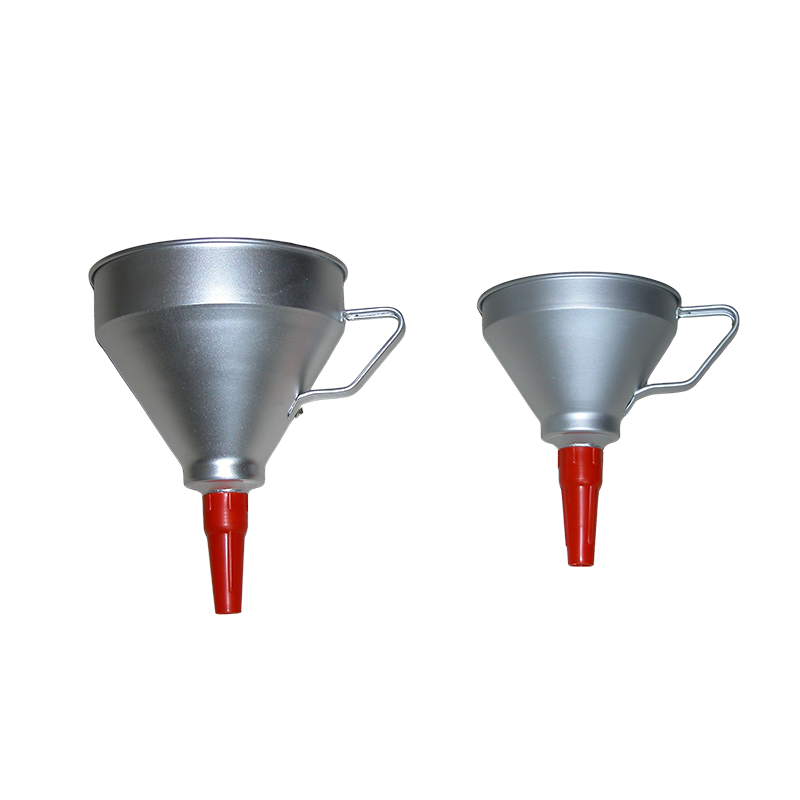
Different geometric designs address specific flow requirements and spatial limitations. Conical funnels represent the standard symmetrical design. They require steeper wall angles to achieve mass flow and are best suited for highly free-flowing materials in environments without vertical space restrictions. The symmetrical nature of a cone means that the material converges from all sides simultaneously, which can increase the compressive stress at the outlet and promote arching if the angle is not steep enough.
Wedge and chisel-shaped funnels feature elongated, slotted outlets. They are highly effective at overcoming arching using shallower wall angles than conical designs. Because material only converges in one dimension (plane flow), the critical arching dimension is typically half that of a conical hopper. However, they require specific downstream equipment, like belt or screw feeders, to draw material evenly across the entire slot. If the feeder only draws from the back or front, the wedge funnel will revert to funnel flow.
Eccentric or asymmetrical funnels use one vertical wall or offset discharge points. These designs force mass flow in restricted footprints or bypass structural obstacles in existing facilities. By having one vertical wall, the material experiences less convergence pressure on that side, which can help break arches. However, asymmetrical designs induce uneven loading on the structure, requiring robust engineering to prevent fatigue or buckling.
Assess Material Properties: Determine bulk density, moisture content, and particle size distribution.
Calculate Space Constraints: Measure available headroom and footprint to determine if steep conical designs are viable.
Evaluate Downstream Equipment: Ensure the selected geometry matches the interface of the feeder or conveyor below.
Determine Flow Requirements: Decide if mass flow is strictly necessary or if funnel flow is acceptable for the specific process.
Transition hoppers are another structural approach, often used when converting a round bin to a square or rectangular outlet. These require careful detailing at the corners, known as valley angles. The valley angle is always shallower than the adjacent side walls. If the valley angle is not steep enough, material will hang up in the corners, leading to spoilage or cross-contamination.
Different manufacturing sectors require specific funnel typologies. In food and beverage production, highly polished, self-draining stainless steel funnels designed for Clean-in-Place (CIP) compatibility are standard. The focus remains on preventing ingredient cross-contamination. Welds must be ground smooth and flush, typically to a specific Ra (Roughness Average) value, to eliminate microscopic pits where bacteria can harbor.
Pharmaceuticals require precision micro-funnels with zero-retention internal welds and specialized anti-static surfaces to ensure dosage and chemical compound integrity. Active Pharmaceutical Ingredients (APIs) are often highly cohesive and prone to static cling. Funnels in this sector frequently utilize electropolishing or specialized fluoropolymer coatings to reduce wall friction to near zero.
Mining and aggregates utilize high-tonnage, heavy-gauge steel hopper funnels lined with wear-resistant materials like Hardox or ceramics to withstand high-impact, high-abrasion raw inputs. The sheer volume and weight of the materials dictate structural designs focused on impact resistance and wear life rather than sanitary finishes. Replaceable liners are common to extend the life of the base structure.
Chemical processing demands corrosion-resistant, alloy-based funnels, such as Hastelloy or Inconel, designed to safely handle highly reactive, acidic, or volatile materials. These environments often require strict adherence to pressure vessel codes and explosive atmosphere regulations. The geometry must ensure complete discharge to prevent dangerous chemical reactions from stagnant material.
Evaluating base materials ensures durability and compliance. Carbon steel is cost-effective for non-corrosive, heavy industrial applications like mining and aggregates. It provides excellent structural strength but requires protective coatings if exposed to moisture. Stainless steel, comparing 304 versus 316L, offers varying levels of corrosion resistance and sanitation required for food processing, pharmaceuticals, and chemical manufacturing. 316L contains molybdenum, providing superior resistance to chlorides and acids.
Specialty alloys and plastics are necessary for extreme abrasion or highly corrosive chemical environments. Ultra-High Molecular Weight (UHMW) polyethylene liners are frequently used to retrofit existing carbon steel funnels, drastically reducing wall friction and promoting mass flow without the cost of a full stainless steel replacement.
| Material | Primary Advantage | Typical Industry | Limitations |
|---|---|---|---|
| Carbon Steel | High strength, low cost | Mining, Aggregates | Prone to rust, high wall friction |
| 304 Stainless Steel | Good corrosion resistance, sanitary | Food & Beverage | Vulnerable to high chlorides |
| 316L Stainless Steel | Excellent chemical resistance | Pharmaceuticals, Chemicals | Higher initial material cost |
| Hardox / AR Steel | Extreme abrasion resistance | Heavy Mining, Cement | Difficult to machine and weld |
Surface finishes and linings play a critical role in flow promotion. Mechanical polishing, electropolishing, or Teflon and UHMW liners reduce wall friction to promote mass flow and lower the required angle of repose. Sanitary requirements dictate weld finishes, such as grinding them smooth and flush, to eliminate bacterial harbor points in sanitary applications. A 2B mill finish might be acceptable for dry, free-flowing plastics, but a #4 directional polish or better is required for dairy powders.
The interaction between the bulk solid and the wall surface is dynamic. Changes in temperature or ambient humidity can alter the wall friction angle. For example, a funnel that discharges perfectly in the winter might bridge in the summer due to increased moisture absorption by the powder. Material selection must account for these environmental variables.
Phase 1 involves conceptualization and empirical flow characterization. This includes evaluating material properties like bulk density, particle shape, moisture content, and cohesion. Determining flow characteristics via laboratory testing, such as shear cell testing and wall friction analysis, establishes minimum outlet dimensions and wall angles. Testing must be conducted under conditions that mimic the actual plant environment, including time consolidation tests to simulate material sitting in the funnel over a weekend.
Phase 2 focuses on 3D CAD modeling and digital prototyping. Engineers translate physical flow data into precise geometric configurations using advanced 3D CAD modeling software. This phase integrates the funnel's structural layout with spatial constraints of the existing plant floor and surrounding piping or machinery. Accurate modeling ensures that transition pieces, flanges, and support brackets align perfectly during installation.
Phase 3 utilizes digital simulation through the Discrete Element Method (DEM). DEM software simulates actual bulk solid particle flow through the CAD model. This identifies potential dead zones, wear spots, and structural stress points virtually before physical fabrication begins. DEM allows engineers to visualize the velocity profile of the material, confirming whether mass flow is achieved and identifying areas where localized wear might require thicker plates or specialized liners.
Conduct comprehensive shear cell testing on representative material samples.
Determine the critical arching dimension and rathole diameter.
Calculate the required hopper half-angle for the chosen wall material.
Develop 3D CAD models incorporating facility constraints.
Run DEM simulations to verify flow patterns and identify wear zones.
Perform Finite Element Analysis (FEA) to verify structural integrity under dynamic loads.
Fabrication follows the engineering phases. Precision cutting, rolling, and welding are required to maintain the exact angles specified by the design. Any deviation during fabrication, such as a slight warp in the plate or a rough weld seam, can alter the wall friction and compromise the flow pattern. Quality control inspections, including dye penetrant testing on welds and surface roughness measurements, are mandatory.
Choosing a Custom Industrial Funnel over standard options involves analyzing the tipping point where the initial engineering cost is outweighed by operational savings. Eliminating manual intervention, such as hammering bins or using air cannons, provides significant long-term value. Hammering damages the equipment, creating dents that further restrict flow, while air cannons consume expensive compressed air and can cause fluidization or flushing of fine powders.
Capacity and throughput calculations require bulk solid testing to determine exact wall friction angles and cohesive strength before finalizing dimensions. Engineering trade-offs occur when facility headroom is too low for the optimal mass-flow cone angle, necessitating transition designs or active discharge aids. If a cone requires a 70-degree angle for mass flow but only 60 degrees is possible due to roof height, engineers must switch to a wedge design or incorporate a bin activator.
Active discharge aids, such as vibratory bottoms or mechanical agitators, introduce moving parts and maintenance requirements. While they can force flow in compromised geometries, they are not a substitute for proper geometric design. A well-engineered static funnel is always preferable to a poorly designed one relying on mechanical aids to function.
Procurement teams must look beyond the initial purchase price. The cost of a custom design includes the engineering hours and testing required to guarantee performance. However, the cost of a standard funnel that fails to flow includes lost production time, wasted material, and the eventual cost of retrofitting or replacing the unit entirely.
Structural integrity and load bearing present significant risks. Underestimating dynamic loads during material discharge can lead to structural fatigue or failure. When material transitions from static to dynamic flow, the pressure on the hopper walls changes dramatically. Mitigation requires finite element analysis (FEA) to ensure support structures account for both dead weight and dynamic flow pressures, known as the switch stress.
Integration with existing equipment carries the risk of mismatched discharge rates between the funnel outlet and downstream feeders, causing bottlenecks or flooding. Designing the funnel and feeder as a single integrated system ensures the interface allows for uniform material draw. If a screw feeder has a constant pitch under a slotted outlet, it will only draw material from the back, creating a rathole. A mass-flow screw feeder with increasing pitch or tapered shaft is required.
Combustible dust and safety compliance involve risks like static buildup or explosive dust environments. Specify proper grounding, explosion venting, and rotary valves to isolate environments. NFPA and ATEX regulations dictate the required vent area based on the volume of the vessel and the explosivity index (Kst) of the dust. Failure to engineer these safety systems can result in catastrophic facility damage.
Installation logistics also pose risks. Large custom funnels may need to be shipped in sections and welded on-site. Field welding introduces the risk of distortion and requires careful control of the welding environment to maintain sanitary finishes. Planning the installation sequence, including rigging and crane access, is a critical part of the engineering process.
Conduct a comprehensive material flow audit on your most problematic bulk solids to identify the root cause of flow stoppages.
Partner with a fabrication firm that possesses in-house shear cell testing and DEM simulation capabilities.
Specify exact surface finish requirements and weld standards in your procurement documents to ensure compliance.
Integrate the funnel design with the downstream feeder specifications to guarantee uniform material draw.
A: Mass flow creates a first-in, first-out dynamic where all material is in motion simultaneously, preventing degradation. Funnel flow creates a first-in, last-out dynamic where a central channel empties first, leaving stagnant material on the walls.
A: The correct angle is determined through shear cell testing, analyzing wall friction, and calculating the material's angle of repose to ensure reliable discharge.
A: Custom funnels are necessary when handling cohesive materials, meeting strict sanitary standards, operating in limited facility headroom, or integrating with legacy equipment.
A: Food-grade funnels typically require 304 or 316L stainless steel, continuous TIG welding, and specific Ra micro-inch finishes to eliminate bacterial harbor points.
A: Prevention involves geometric redesigns, steeper wall angles, slotted outlets, and sometimes the secondary use of mechanical flow aids.
A: Required data includes bulk density, particle size, moisture content, throughput requirements, dynamic load calculations, and dimensional constraints.


