+86-25-8470-5507


Views: 0 Author: Site Editor Publish Time: 2026-08-08 Origin: Site


High-speed manufacturing faces a critical vulnerability: material handling bottlenecks where continuous flow meets discrete processing. When bulk materials move from storage to precision dosing, the transition must be flawless. Improper material feeding leads to line starvation, product inconsistency, equipment jamming, and unacceptable downtime in automated environments. The entire production line suffers when the feed rate fluctuates or stops entirely due to poor integration.
Engineered industrial Funnels and automated feeding systems serve as the necessary bridge between bulk material storage and precision production stages. They transform unpredictable bulk solids into a controlled, measurable stream. Integrating these systems requires a deep understanding of material science, mechanical engineering, and control logic. This technical evaluation guide explores how to successfully integrate these components into automated production lines to ensure seamless material flow and eliminate processing bottlenecks.
Material Flow Dictates Design: The physical properties of the handled material (bulk density, moisture content, abrasiveness) are the primary drivers for selecting the correct funnel geometry and material.
Integration Requires Synchronization: An Automatic Feeding Funnel must communicate seamlessly with downstream equipment via PLCs and sensors to prevent overfeeding or line starvation.
Customization vs. Standardization: While off-the-shelf funnels offer lower initial costs, custom-engineered solutions drastically reduce long-term maintenance and mitigate flow issues like bridging and ratholing.
Compliance is Non-Negotiable: Funnel integration must account for industry-specific regulations, including ATEX/OSHA for combustible dust and FDA/3-A sanitary standards for food and pharma.
Successful integration requires establishing clear baseline metrics. You must achieve consistent volumetric or gravimetric throughput, minimal material degradation, and zero unplanned downtime. The transition from manual loading to continuous, automated feeding demands absolute reliability. If the funnel cannot deliver material at the exact rate required by the downstream process, the automation fails. We measure success by looking at the standard deviation of the feed rate over a specific time interval. A tight tolerance indicates a well-integrated system.
Consider the shift from manual dumping to automated dosing. Manual processes introduce human error, inconsistent batch sizes, and safety hazards. Automated systems, when properly designed, eliminate these variables. They provide a steady, predictable supply of material, allowing downstream equipment to operate at peak efficiency.
Legacy systems often suffer from erratic feed rates, material segregation, and frequent manual intervention. Operators hitting hoppers with mallets is a clear sign of a failing system. These bottlenecks severely impact Overall Equipment Effectiveness (OEE). Analyzing these failure points helps determine whether the issue lies in the funnel geometry, the material characteristics, or the lack of automated flow aids.
Common failure points include:
Inconsistent discharge rates causing downstream equipment to idle.
Material segregation where larger particles separate from fines, ruining batch consistency.
Frequent bridging requiring operators to physically break the jam.
Dust generation creating hazardous work environments and material loss.
Apply connected-system principles by designing physical funnel stages so that data and material from upstream storage dynamically optimize downstream dosing rates. Real-time performance indicators prevent upstream overflows and downstream starvation. The funnel acts as a buffer and a metering device, requiring constant communication with the entire line.
This synchronization relies on a robust control architecture. Upstream conveyors must slow down if the funnel approaches maximum capacity. Conversely, if the funnel level drops below a critical threshold, the system must alert operators or automatically trigger a refill sequence before the downstream process runs dry.
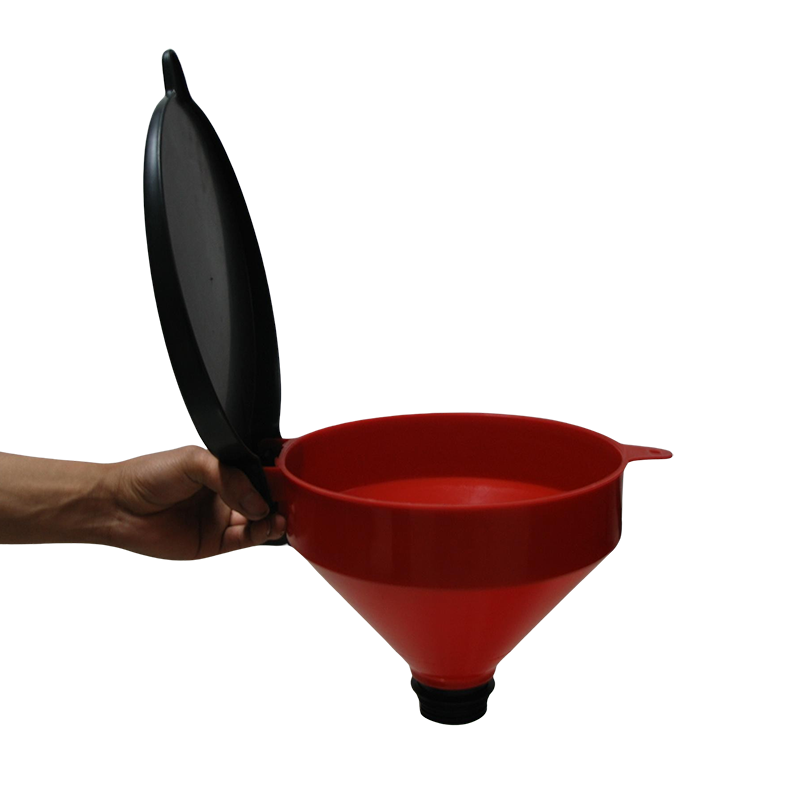
Gravity-fed funnels rely entirely on mass flow and funnel flow dynamics. They are best suited for free-flowing, non-cohesive bulk solids like plastic pellets or dry grains. However, their limitations become apparent with cohesive materials. They are highly susceptible to arching and require specific wall friction angles to maintain consistent discharge.
When designing a gravity-fed system, engineers must calculate the critical arching dimension. This is the minimum outlet size required to prevent the material from forming a stable bridge across the opening. If the outlet is too small, the system will fail regardless of the upstream automation.
Vibratory feeder funnels integrate electromagnetic or electromechanical drives to stimulate material flow. They excel with interlocking particles, fragile materials requiring gentle handling, and precise dosing applications. The vibration fluidizes the material, preventing bridging and ensuring a steady feed rate without mechanical degradation.
These systems offer excellent control over the feed rate by adjusting the amplitude and frequency of the vibration. This makes them ideal for applications where the material characteristics change slightly between batches, as the system can be tuned on the fly to maintain optimal flow.
Volume-based feeding utilizes rotary valves or augers to deliver a set volume of material per revolution. Weight-based feeding, such as loss-in-weight feeders, measures the actual mass being discharged. Gravimetric systems offer superior accuracy for critical compounding and mixing lines, compensating for variations in bulk density.
| Feature | Volumetric Feeding | Gravimetric Feeding |
|---|---|---|
| Operating Principle | Discharges a fixed volume per unit of time. | Discharges a fixed weight per unit of time. |
| Accuracy | Moderate (susceptible to bulk density changes). | High (compensates for bulk density changes). |
| Complexity | Lower mechanical and control complexity. | Higher complexity (requires load cells and advanced PLCs). |
| Best Use Case | Consistent materials, non-critical dosing. | Variable materials, critical compounding recipes. |
Material testing is mandatory. You must evaluate shear strength, wall friction, and bulk density. Engineered solutions address common flow problems like bridging (arching), ratholing, and flushing. Designing the funnel based on empirical material data ensures reliable discharge and prevents costly retrofits.
Testing should simulate the actual conditions the material will face in the production environment. This includes temperature variations, humidity levels, and the time the material will sit at rest in the funnel before discharge. A material that flows perfectly when dry may turn into a solid block after sitting in a humid environment for 24 hours.
Evaluate the physical constraints of integrating new funnels into existing line layouts. Consider headroom requirements, discharge angles, and access for maintenance. Mechanical interfacing requires flexible connections to isolate vibration, isolation valves for maintenance, and robust structural supports to handle dynamic loads.
Retrofitting often involves working around existing structural beams, piping, and electrical conduits. 3D scanning the installation area is a standard practice to ensure the new funnel and its associated feeding equipment will fit without requiring major modifications to the facility.
The automation layer requires integrating level sensors (capacitance, ultrasonic, radar) with centralized PLCs. Establishing automation trigger benchmarks involves configuring initial sequence logic that activates the feeding based on volumetric levels or system-demand pulses. Real-time flow monitoring utilizes continuous sensor feedback to detect physical flow drop-offs, triggering automated remedial sequences like activating vibrators or fluidizers. Closed-loop control systems ensure real-time feed rate adjustments.
Install continuous level sensors to monitor inventory in real-time.
Configure point level sensors as high/low fail-safes.
Integrate flow-detect sensors at the discharge to confirm material movement.
Program the PLC to activate flow aids automatically if a drop in discharge rate is detected.
Machine learning models analyze continuous sensor data from the funnel to optimize performance. Predicting material flow interruptions, such as micro-bridging, before physical blocks occur is possible by analyzing motor current and acoustic emission sensors. This predictive approach minimizes downtime and extends equipment life.
By establishing a baseline of normal operation, AI algorithms can detect subtle anomalies. For example, a slight increase in the torque required by an auger feeder might indicate that the material is becoming more cohesive, allowing operators to adjust the process parameters before a complete jam occurs.
Analyze requirements for specific environments. Food and pharmaceutical applications demand CIP (Clean-In-Place) capabilities and sanitary welds. Environments handling combustible dust require ATEX certification and explosion venting. Ergonomic safety for maintenance access must be integrated into the structural design.
Sanitary designs eliminate crevices where bacteria can harbor. This requires continuous, polished welds and the use of FDA-compliant materials. For combustible dust, the funnel must be designed to contain or safely vent an explosion, protecting both the personnel and the surrounding equipment.
Compare the high upfront CapEx of custom geometries against the operational drag of retrofitting standard funnels. Asymmetrical cones and specialized coatings prevent flow issues but require higher initial investment. Standard funnels may seem cost-effective initially but often lead to chronic production delays.
A custom-engineered funnel is designed specifically for your material and your process. It accounts for the exact wall friction angle required for mass flow. An off-the-shelf funnel is a compromise. It might work for a variety of materials, but it is rarely optimized for any single one, leading to flow problems that require constant manual intervention.
Evaluate the trade-off between complex active feeding systems and passive gravity funnels. Active systems offer higher precision but require more maintenance. Passive systems have lower maintenance needs but offer lower precision. The choice depends on the required accuracy and the material's flow characteristics.
Active systems, like vibratory or auger feeders, have moving parts that wear out and require regular servicing. However, they provide the precise dosing necessary for high-quality manufacturing. Passive systems are simpler and more robust, but they cannot guarantee the same level of accuracy, which can lead to product waste or quality issues downstream.
Inaccurate level readings lead to dry runs or overflows. Mitigate this risk by implementing redundant sensor arrays and establishing strict calibration schedules. Regular verification ensures the control system receives accurate data.
A single sensor failure should not bring down the entire line. By using multiple sensor technologies (e.g., combining radar for continuous level with capacitance probes for high/low limits), you create a robust control system that can tolerate individual component failures.
Unpredictable changes in material lots, such as higher moisture content, cause sudden bridging. Integrate flow aids like pneumatic fluidizers, mechanical agitators, or industrial vibrators. Tie these aids to automated fault-detection logic to resolve jams without manual intervention.
| Flow Problem | Cause | Automated Mitigation Strategy |
|---|---|---|
| Bridging (Arching) | High cohesive strength, small outlet. | Activate pneumatic fluidizers or mechanical agitators via PLC logic. |
| Ratholing | Funnel flow pattern, material buildup on walls. | Utilize industrial vibrators to collapse the rathole and induce mass flow. |
| Flushing | Aerated fine powders acting like a liquid. | Implement rotary valves to control discharge and allow material to deaerate. |
Abrasive materials degrade funnel walls, leading to contamination or structural failure. Specify wear-resistant liners like UHMW polyethylene or AR steel. Conduct routine thickness testing to monitor wear and schedule proactive replacement.
The impact zone where material enters the funnel is particularly susceptible to wear. Installing replaceable wear plates in these high-impact areas extends the life of the main funnel structure and simplifies maintenance.
Conduct a professional bulk material flow test to determine the exact physical properties of your product.
Consult with a systems integrator to draft initial CAD layouts and PLC integration plans based on your facility footprint.
Select the appropriate feeding technology based on your required accuracy and material characteristics.
Establish a rigorous maintenance schedule, including sensor calibration and wear liner inspection.
A: In mass flow, all material is in motion during discharge, preventing stagnation. In funnel flow, an active channel forms in the center while material at the walls remains stationary, leading to ratholing and erratic discharge.
A: Prevent bridging by designing the funnel with the correct wall angle and outlet size based on material testing. Additionally, integrate flow aids like vibrators, mechanical agitators, or pneumatic fluidizers.
A: Automation typically requires continuous level sensors (radar, ultrasonic, or capacitance) to monitor inventory, point level sensors for high/low alarms, and flow-detect sensors to confirm material discharge.
A: Choose a vibratory funnel when handling interlocking particles, fragile materials that degrade under mechanical agitation, or when precise, gentle dosing is required.
A: Integration requires mapping the new funnel's sensor outputs and control inputs to the legacy PLC. This often involves using communication gateways or upgrading specific I/O modules to handle the new data streams.
A: Sanitary funnels must feature continuous, polished welds, FDA-compliant materials (typically 304 or 316L stainless steel), and designs that allow for Clean-In-Place (CIP) or easy disassembly for cleaning.
A: Higher moisture increases material cohesion, making it prone to bridging and adhering to funnel walls. Design adjustments include steeper wall angles, specialized non-stick coatings, and active flow aids.


