+86-25-8470-5507


Views: 0 Author: Site Editor Publish Time: 2026-09-21 Origin: Site


Picture this. You are out in the field. A storm is rolling in, and you need to refuel a combine harvester fast. Or perhaps you manage a high-volume maintenance garage. Suddenly, a mismatched spout restricts your flow. Fuel splashes back onto the machinery. Frustrating downtime piles up. Are you tired of spilling expensive fuel during these critical transfers?
Using the wrong spout size will ruin your entire fluid transfer setup. Choosing the correct hardware is not just about convenience. It is a critical engineering decision that prevents costly misfueling mistakes and hazardous environmental spills. In this guide, we break down the precise technical differences between standard and narrow spouts. By the end, you will know exactly how to select the perfect manual tool for your specific vehicles, heavy machinery, or stationary storage tanks.
Standard Spouts (typically 15/16" or larger): Best suited for heavy machinery, agricultural tractors, and large commercial storage tanks due to their high volume capacity (up to 120 L/min).
Narrow Spouts (typically 13/16"): Essential for unleaded petrol vehicles and small utility engines equipped with internal restrictor plates.
Misfueling Prevention: Spout dimensions act as a physical safeguard. They actively prevent operators from accidentally pumping diesel into a petrol tank.
Manual vs. Auto: Mechanical dispensing offers cost-effective, precise flow control. This makes it the superior choice for low-pressure, gravity-fed farm tanks.
Before upgrading your transfer hardware, you need to know how these tools actually work. Fuel dispensing demands precision. It requires rugged reliability and strict safety. All of these factors depend entirely on the internal design of your equipment.
A high-quality manual dispensing nozzle is a straightforward, mechanically operated device. It directs the flow of liquid from a storage tank into a vehicle reservoir. Unlike automatic variants—which rely on a complex internal Venturi tube and pressure-sensitive sensors—a manual tool puts you in complete control. You manually squeeze the trigger to open the internal poppet valve. Fluid flows immediately. To stop the delivery, you simply release the lever. A heavy-duty internal spring instantly snaps the valve shut.
The internal mechanics are simple, yet highly robust. Because there are no delicate automatic shut-off sensors blocking the path, fluid dynamics flow directly through the aluminum alloy body. This streamlined internal path reduces friction. It allows for consistent, uninterrupted delivery even under less-than-ideal pumping conditions.
For many industrial and agricultural applications, we prefer manual nozzles over their automatic counterparts. Primarily, they are significantly more cost-effective. Removing complex auto-shutoff components makes them cheaper to manufacture and much easier to maintain. Furthermore, fewer moving parts directly translates to a lower failure rate. When you are working in harsh environments filled with dust, mud, or freezing temperatures, mechanical reliability is everything.
Most importantly, manual tools stand out as the superior choice for gravity-fed tanks. Automatic nozzles require a specific minimum flow rate and pressure differential to keep their valves open. In a gravity-fed farm setup, the hydrostatic pressure is often too low. This causes an automatic nozzle to constantly "click off" and halt your work. A manual design bypasses this frustrating issue entirely, providing smooth flow regardless of the system's head pressure.
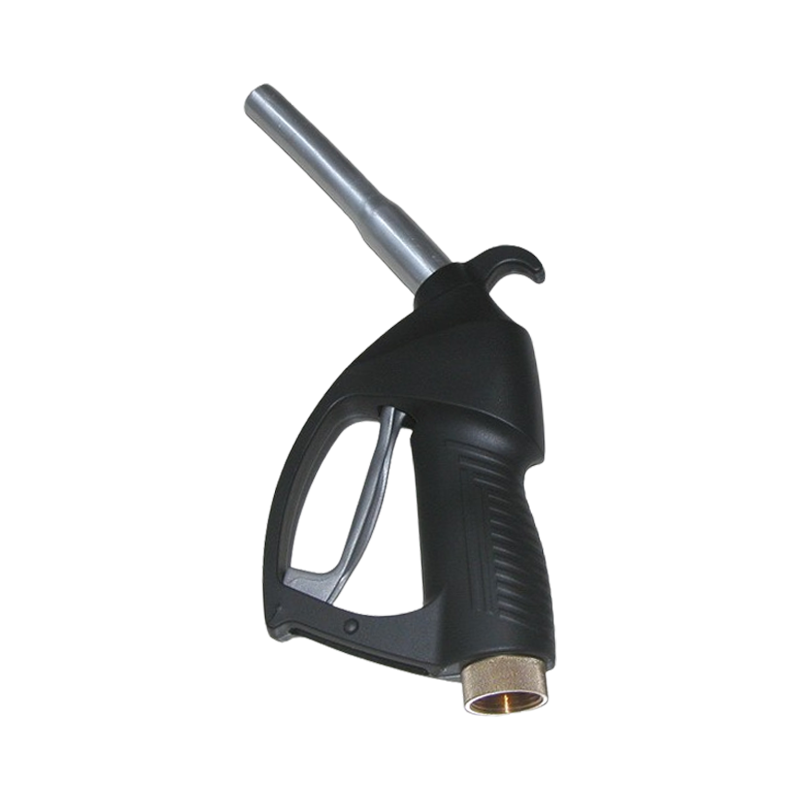
The most critical physical characteristic of any dispensing hardware is the spout itself. This metal tube dictates what type of machinery you can fill. It also controls the speed and overall safety of the transfer process.
Spout dimensions are strictly standardized across the industry. This engineering standard prevents cross-contamination and ensures compatibility with vehicle manufacturing rules.
Standard Spouts: Built for heavy-duty applications. These spouts feature an outer diameter of approximately 23.8 millimeters (15/16 of an inch).
Narrow Spouts: Designed specifically for lighter, volatile liquids. These spouts utilize a smaller outer diameter of approximately 20.6 millimeters (13/16 of an inch).
| Feature | Standard Spout | Narrow Spout |
|---|---|---|
| Outer Diameter | ~23.8mm (15/16") | ~20.6mm (13/16") |
| Primary Fuel Type | Diesel, Biodiesel, Kerosene | Unleaded Petrol / Gasoline |
| Flow Rate Capacity | High (Up to 120 LPM / 30+ GPM) | Moderate (Up to 60 LPM / 15 GPM) |
| Target Application | Heavy machinery, commercial trucks | Passenger cars, portable jerry cans |
The diameter of the spout directly impacts your maximum flow rate. Based on the principles of fluid dynamics, a larger internal diameter reduces fluid velocity and friction. This allows a massive volume of liquid to pass through without generating excessive back-pressure.
A standard spout comfortably handles high-flow delivery up to 120 liters per minute (LPM). In contrast, if you attempt to force a high flow rate through a narrow spout, the sudden restriction creates severe back-pressure. This bottleneck leads to foaming, violent splashing, or even blown seals within your transfer pump. Therefore, matching the spout size to your pump's output rating is a non-negotiable engineering requirement.
When dealing with heavy-duty equipment, sheer volume and efficiency are your primary concerns. The standard spout is engineered specifically to tackle these demanding operational requirements.
Industrial excavators, bulldozers, and massive agricultural tractors feature high-capacity tanks. These machines require a dedicated diesel fuel nozzle to minimize downtime. Their large, open fill points easily accommodate the wider 15/16" standard spout. Using this larger diameter ensures a snug, secure fit within the filler neck. It prevents the hardware from vibrating out during operation, effectively eliminating the risk of accidental environmental spills.
Commercial fleet vehicles often utilize saddle tanks ranging from 100 to over 300 gallons. Refueling tanks of this magnitude with a narrow spout would result in agonizingly slow transfer times. A standard spout facilitates rapid, high-flow dispensing. By minimizing internal resistance, the wider opening allows your high-capacity transfer pumps to operate at peak efficiency without straining the electric motor.
While standard spouts prioritize raw volume, narrow spouts are built for absolute precision. They ensure strict compatibility with modern vehicle safety standards.
The anatomy of a modern passenger car's fuel neck is highly regulated. Vehicles running on unleaded petrol are manufactured with a protective restrictor flap located just inside the filler neck. This metal or plastic flap features a small opening, typically just over 21mm in diameter.
A narrow spout fuel nozzle is explicitly engineered to bypass this exact flap. It slides smoothly into the opening, pushing the plate aside to deliver liquid directly into the tank. Conversely, a standard 23.8mm spout is physically too large to pass through. This brilliant industry standard serves as a foolproof physical safeguard, guaranteeing that an inattentive operator cannot accidentally pump heavy oil into a passenger vehicle.
Beyond passenger cars, narrow spouts are absolutely essential for servicing small utility engines. Lawnmowers, ATVs, portable generators, and standard plastic jerry cans feature very narrow, awkwardly positioned fill points. Using a high-flow, wide spout on these small reservoirs almost guarantees a hazardous overflow. A narrow spout provides the operator with superior visual clearance and pinpoint flow control. You can safely fill small tanks without splashing highly flammable liquid onto a hot engine block.
Industrial garages and agricultural maintenance sheds require integrated, versatile solutions. Selecting the correct hardware to match your broader system is vital for daily operational efficiency.
A manual tool does not operate in isolation. It is the final, critical component of your overall workshop fueling equipment. When assessing your setup, evaluate your storage containers. Are you using 55-gallon drums, 275-gallon IBC totes, or large underground tanks? Each storage method utilizes different transfer mechanisms, such as 12V/24V electric transfer pumps or pneumatic systems. The dispensing hardware you select must match the thread size (usually 3/4" or 1" NPT/BSPT) and output capacity of these pumps. Attaching a 120 LPM commercial pump to a narrow spout will cause immediate system strain and potential hose ruptures.
Recent market analysis reveals a fascinating shift in the fluid transfer industry. While complex automation dominates retail gas stations, there is a massive resurgence in demand for high-durability, precision-engineered manual nozzles across off-grid, agricultural, and heavy industrial sectors. Why is this happening?
The answer lies in reliability. Rising replacement costs and frequent failures of electronic auto-shutoff components in extreme weather have pushed site managers back to mechanical solutions. Furthermore, stricter environmental regulations regarding soil contamination are forcing manufacturers to refine these manual designs. Modern units now feature tighter spout tolerances, advanced multi-plane swivels, and upgraded Viton O-rings that resist degradation from harsh biofuels. This evolution ensures that a purely mechanical tool can easily meet contemporary environmental safety standards while delivering the rugged, fail-proof performance that heavy industries demand.
Misfueling is a catastrophic error. Introducing the wrong type of combustible liquid into an engine costs industries millions of dollars annually in severe repairs and operational downtime.
Mixing these liquids causes severe mechanical damage. This happens because their combustion properties are entirely different.
Diesel in a Petrol Engine: Heavy oils are less volatile. They will not ignite properly via spark plugs. If introduced into a passenger car, the engine will misfire, smoke heavily, and eventually stall completely. The entire fuel system must be drained and professionally cleaned.
Petrol in a Diesel Engine: This scenario is significantly more destructive. Heavy oils act as a critical lubricant for high-pressure injection pumps. Volatile petrol acts as a harsh solvent, instantly stripping away this vital lubrication. Running it through a heavy-duty engine causes catastrophic metal-on-metal friction, rapidly destroying the injection pump and potentially the entire engine block.
The physical size difference between a narrow petrol nozzle and a standard wider spout is your very first line of defense against these devastatingly costly mistakes.
Selecting the correct equipment requires a systematic, objective approach. Do not rely on guesswork when outfitting your maintenance station. Follow these engineering steps:
Audit the exact fluids you intend to pump. Are you transferring heavy oils, Kerosene, or Bio-diesel blends? If your operation strictly handles heavy machinery, a standard spout is mandatory for high-volume efficiency. If you are servicing fleet vehicles or landscaping equipment, a narrow spout is required.
Do not rely on visual assumptions. Grab a pair of non-sparking calipers. Accurately measure the internal diameter of the filler necks on your machinery. Pay close attention to any internal restrictor plates located an inch down the neck. If the internal diameter measures less than 23.5mm, you must purchase a narrow spout model.
Your new hardware must securely connect to your existing delivery hose. Check the inlet size on your pump hose. Standard industrial sizes are 3/4-inch (common for 60 LPM setups) and 1-inch threads (for 120 LPM high-volume transfer). Verify the thread type—typically NPT in North America or BSPT internationally. Specifically, we highly recommend installing a multi-plane swivel connector between the hose and the inlet. This prevents hose kinking and drastically reduces operator wrist strain during long shifts.
Even the most robust aluminum alloy equipment requires proper handling and routine maintenance to ensure a hazard-free working environment.
Because a manual tool lacks an automatic shut-off mechanism, preventing overfills rests entirely on your shoulders. Never walk away. Never prop the trigger open with a foreign object. Continuous auditory and visual monitoring is required. Actively listen to the sound of the fluid entering the tank. As the tank nears capacity, the pitch of the displaced air escaping the neck will noticeably rise. That is your signal to instantly release the trigger.
Implement a strict preventative maintenance schedule. First, inspect the internal Viton O-rings and seals around the valve stem for cracking or swelling. Second, wipe down the metal spout regularly to remove mud, rust, or metallic debris. Finally, ensure the trigger mechanism moves smoothly. If the lever feels gritty or fails to snap shut instantly upon release, pull the unit from service immediately.
Choosing the right dispensing hardware ultimately depends on your specific fluid type, pump flow rate, and the physical dimensions of your equipment's fill points. Standard spouts are the undisputed champions for high-volume, heavy-duty machines. In contrast, narrow spouts are crucial for protecting passenger engines from misfueling and servicing small utility tanks safely.
Investing in the proper precision tools ensures daily workplace safety, drastically speeds up your workflow, and protects expensive engines from catastrophic damage. Before making a purchase, always review your system's pump pressure and hose thread compatibility.
Ready to upgrade your fluid transfer setup? Explore a wide range of rugged, precision-engineered manual nozzles tailored for both high-flow industrial and precise narrow-spout applications at Jinlin Industrial to find the perfect match for your operational needs today.
Generally, no. A standard heavy-duty tool is engineered with a wider spout, measuring 15/16 inches (approximately 23.8mm) in outer diameter. Modern passenger vehicles are equipped with a restrictor plate inside the filler neck designed specifically to block larger spouts. This deliberate safety mechanism prevents accidental misfueling. Attempting to force a wider spout into a restricted neck will not work and causes dangerous splash-back.
A narrow spout is specifically dimensioned to interface with restricted fill points. The industry standard outer diameter for these spouts is 13/16 inches, which translates to approximately 20.6mm. This precise sizing allows the metal tube to easily bypass safety flaps, ensuring a secure fit deep enough into the neck to dispense highly volatile liquids safely.
Your choice depends entirely on your pump's output capacity and your delivery hose size. A 3/4-inch inlet is the standard for moderate flow applications (up to 60 LPM / 15 GPM) and fits most standard workshop transfer pumps. A 1-inch inlet is designed for high-volume commercial transfer (up to 120 LPM / 30+ GPM). Always match the nozzle inlet directly to your existing hose fittings to avoid flow restriction.
Yes, you can, but with one critical caveat. Your electric transfer pump must be equipped with an internal bypass valve. Because a manual tool requires you to physically stop the flow by releasing the trigger, the pump will continue running for a few moments. An internal bypass valve allows the fluid to safely recirculate inside the pump housing, preventing the motor from over-pressurizing and burning out.
A restricted flow rate is rarely the fault of the tool's basic mechanical design. It is usually an issue of system compatibility. The most common cause is a mismatched spout size creating excessive back-pressure—for example, trying to push 120 LPM from a commercial pump through a narrow 13/16-inch spout. Other frequent culprits include a clogged particulate filter on the transfer pump, debris trapped in the inlet strainer, or utilizing a gravity-fed tank that lacks sufficient head pressure.


