+86-25-8470-5507


Views: 0 Author: Site Editor Publish Time: 2026-08-01 Origin: Site


In industrial manufacturing, bulk processing, and waste management, the precise control of material flow is a mandatory operational requirement. Facility managers frequently conflate the terminology for the equipment used on the floor. Misidentifying the functional differences between flow-control devices and storage containers leads to facility bottlenecks, material spillage, structural overloading, and inefficient waste disposal workflows. When a plant attempts to use a transit device for storage, or a storage vessel for high-speed transit, the entire production line suffers.
This guide addresses physical, industrial material handling equipment rather than digital sales funnels or software analytics tools. Resolving material handling bottlenecks requires a strict technical evaluation of your facility needs. We break down the engineering distinctions between flow devices and storage vessels, providing a framework to determine which system aligns with your continuous flow or batch storage requirements. You will learn how to evaluate material characteristics, assess workflow demands, and mitigate common implementation risks on the factory floor.
Functional Distinction: A funnel is strictly a flow-control device designed to guide material into a narrower receptacle; it is not engineered to store or hold bulk material.
Storage Capacity: A hopper system is a specialized container built to store, hold, and transport bulk materials or waste, often utilizing a funnel-shaped discharge point for controlled release.
Operational Alignment: Choosing between the two depends entirely on whether your process requires continuous material transit (funnels) or batch accumulation and delayed dumping (hoppers).
The Chute Factor: Chutes offer directional, gravity-fed transport across lateral distances, whereas funnels focus on vertical convergence.
Risk Mitigation: Selecting the wrong geometry or system type can result in severe material flow issues, including bridging, ratholing, or catastrophic structural failure under load.
An industrial funnel serves a specific structural purpose. It guides liquid, powder, or bulk solids from a wider opening to a narrower target. The primary function is convergence and direction. These devices lack retention capability. They rely entirely on gravity for immediate throughput. Material enters the top and exits the bottom without delay, assuming the throat diameter is appropriately sized for the flow rate. If you block the bottom, you risk structural failure because the thin walls cannot handle static outward pressure.
Common industrial applications involve directing liquid chemicals into vats, guiding machined parts into packaging, or channeling bulk powders into secondary processing equipment. The design prioritizes smooth transit and minimal resistance. Engineers specify steep wall angles to ensure materials do not accumulate within the cone. You will often see Funnels mounted directly above packaging lines or chemical mixing tanks where uninterrupted flow is mandatory.
When designing a flow-control device, engineers must calculate the exact discharge rate needed to match the downstream equipment. If the throat is too wide, the downstream machine floods. If the throat is too narrow, material backs up and spills over the top edge. This precise sizing requires accurate data on the material's bulk density and flow characteristics.
A Hopper System is a high-capacity bin or container designed for the temporary storage and eventual discharge of bulk materials. Unlike a simple transit cone, a hopper is engineered to hold massive weight and volume over extended periods. It integrates storage volume with a tapered bottom to facilitate gravity-assisted discharge when required. The walls are built from heavy-gauge steel or reinforced polymers to withstand the static load of tons of material.
These systems come in various configurations. Self-dumping units are used heavily in waste management and forklift-operated material handling. These systems allow operators to collect scrap, metal offcuts, or raw materials, transport them across the facility, and release the contents safely. Stationary units often sit above conveyor belts, holding a buffer supply of raw materials to ensure the production line never runs dry even if the primary delivery truck is late.
The geometry of the storage vessel dictates how material flows out of it. Mass flow designs ensure all material moves simultaneously during discharge, preventing stagnant zones. Funnel flow designs allow material in the center to move while material on the walls remains stationary until the center empties. Selecting the right flow pattern is a core engineering task.
Industrial chutes are open or closed troughs used to slide materials down a slope. They provide directional, gravity-fed transport across lateral distances. While conical devices focus on vertical convergence and storage bins focus on volume-based retention, chutes are primarily about moving material from one elevation to a lower one across a horizontal span.
Chutes handle everything from aggregate rock in mining operations to cardboard boxes in fulfillment centers. The slope angle must overcome the friction between the material and the chute surface. If the angle is too shallow, material stops. If it is too steep, material accelerates too fast and damages equipment at the bottom.
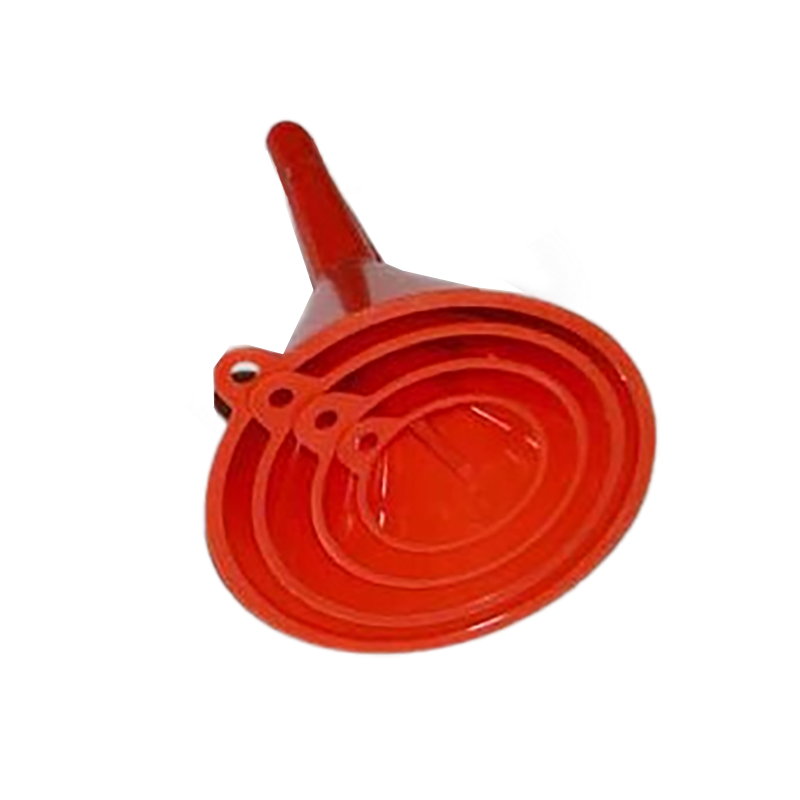
The most significant difference lies in volume and retention capabilities. Transit cones feature a zero-retention design. They are not built to hold material. A storage vessel, conversely, has a calculated volumetric capacity. Load-bearing engineering differs drastically. A storage bin must support the static weight of accumulated material, whereas a transit cone only deals with the kinetic friction of material passing through.
To illustrate this, consider the structural reinforcement required for a bin holding 5,000 pounds of wet sand. The walls must resist outward hydrostatic pressure. The support legs must transfer that load to the concrete floor without buckling. A transit cone handling the same sand only needs to support the weight of the sand actively falling through it at any given second, which might only be 50 pounds.
| Feature | Transit Device (Funnel) | Storage Vessel (Hopper) |
|---|---|---|
| Primary Function | Immediate material transit and convergence | Batch storage and controlled discharge |
| Retention Capacity | Zero (continuous flow only) | High (calculated volumetric capacity) |
| Structural Load | Kinetic friction and minimal dynamic weight | High static weight and outward pressure |
| Discharge Control | Fixed throat diameter | Mechanical gates, valves, or dump levers |
Transit devices dictate flow strictly through their throat diameter and slope angle. The rate of discharge is continuous and unalterable once the material is introduced. You cannot easily stop the flow halfway through. Storage bins utilize mechanical gates, slide valves, rotary valves, or self-dumping release levers to control when and how fast stored material is discharged. This allows for precise batch processing and controlled dumping.
Slide valves are common on stationary bins. An operator or automated pneumatic cylinder pulls a steel plate back to open the discharge throat. Rotary valves provide metered discharge, dropping a specific volume of material with each rotation. These mechanisms require maintenance and clear operating procedures to prevent jamming.
Spatial requirements vary significantly on the factory floor. Transit devices typically require vertical clearance between existing machinery, acting as a bridge between two processes. They take up very little horizontal space. Storage bins require dedicated floor space, robust structural supports, or forklift accessibility for transport and dumping operations. Integrating a large bin requires planning for access and load-bearing floor capacities.
Measure the available vertical clearance between the discharge point of the upstream machine and the intake of the downstream machine.
Calculate the required buffer volume to keep the downstream machine running during upstream changeovers.
Determine the floor loading capacity of the concrete slab where the support legs will rest.
Map the forklift travel paths to ensure operators can safely access and remove mobile bins without hitting stationary equipment.
Evaluating bulk density, moisture content, abrasiveness, and particle size dictates equipment choice. Highly viscous liquids or cohesive powders behave differently in continuous flow versus static storage. Abrasive materials require hardened surfaces, while cohesive powders might need steeper angles to prevent sticking.
Dry plastic pellets flow easily and require minimal wall steepness. Wet clay or powdered sugar tends to clump and stick to walls. When storing cohesive materials, engineers must design bins with very steep walls and large discharge openings to ensure the material actually falls out when the gate opens. Sometimes, mechanical agitation is required.
Specify a transit cone to prevent bottlenecks in high-speed manufacturing lines where continuous flow is essential. A storage bin is required for batch processing, such as accumulating waste, offcuts, or raw materials for periodic transport. The choice depends on whether the process demands constant movement or intermittent collection and release.
In a continuous baking facility, flour must flow constantly into the mixers. A transit cone ensures the flour drops exactly where needed without spilling. In a metal fabrication shop, steel scrap is generated intermittently. A mobile bin collects this scrap over an eight-hour shift. At the end of the shift, a forklift takes the bin to the recycling dumpster.
Dump cones control the speed and direction of waste poured into a larger stationary disposal vessel below, offering no retention capacity. Self-dumping bins are heavy-duty, mobile units that collect, store, and transport waste materials across the facility before safely dumping them via forklift-activated release mechanisms.
Using a dump cone over a stationary compactor prevents trash from spilling onto the floor when employees empty small trash cans. Using a self-dumping bin allows one forklift operator to manage the waste output of ten different CNC machines without ever leaving the driver's seat. This improves efficiency and reduces manual lifting injuries.
Standard transit cones have a lower initial procurement cost compared to the higher capital investment required for heavy-duty storage systems. However, analyze the return on investment of mobile bins in reducing forklift trips, labor costs, and manual handling during waste disposal. A well-implemented storage system can significantly reduce long-term operational expenses.
Buying ten cheap plastic cones might seem cost-effective, but if employees spend two hours a day sweeping up spilled material because the cones cannot handle surge volumes, the labor cost quickly exceeds the price of a proper storage bin. Evaluate equipment based on how it impacts daily labor hours and machine uptime.
Consider the trade-off between dedicating floor space to a storage system versus the potential mess and inefficiency of using a transit cone over an unoptimized bin. Space constraints often dictate the feasibility of installing large storage units, requiring creative integration or the use of mobile self-dumping units.
If your facility has low ceilings, you cannot install a tall, steep-walled bin. You might have to use a wider, shallower bin with a mechanical discharger to force the material out. This saves vertical space but increases mechanical complexity and maintenance requirements.
Evaluate OSHA considerations regarding manual lifting, material spillage hazards, and the safety of automated self-dumping mechanisms. Mobile bins reduce manual handling and the associated risk of back injuries. Proper transit cone implementation prevents hazardous spills and slips on the factory floor.
When material spills, it creates a slip hazard. If the material is combustible dust, a spill creates an explosion hazard. Containing the material flow with properly sized equipment is a fundamental safety requirement. Ensure all mobile bins have secure latching mechanisms so they do not accidentally dump their contents while being transported across the facility.
Cohesive materials risk jamming in the convergence zone of either device, causing bridging or ratholing. Bridging occurs when material forms an arch over the discharge opening, stopping all flow. Ratholing occurs when a small channel of material flows down the center, leaving stagnant material packed against the walls.
Mitigation involves calculating the correct mass flow angle based on the material's internal friction. Engineers utilize asymmetric cones, which have one straight wall and one angled wall, to disrupt the formation of bridges. Installing pneumatic vibrators or air cannons on the exterior walls can also knock loose stubborn material and restore flow.
Treating a transit cone as a storage bin by blocking its discharge and allowing heavy material to back up leads to structural failure. The thin walls will buckle under the outward pressure. Mitigate this by specifying equipment based on maximum static load calculations and ensuring proper structural reinforcement if temporary accumulation is unavoidable.
If a downstream machine jams, the upstream material must go somewhere. Install level sensors in the transit cone. When the material backs up and hits the sensor, it automatically shuts off the upstream feed. This prevents overloading and protects the equipment from structural fatigue.
Rapid degradation at the discharge throat occurs due to high-velocity material friction. Aggregate rock, glass cullet, and metal shavings will quickly wear through standard mild steel. Specify hardened steel alloys, replaceable liners, or specialized ceramic coatings for high-wear zones to extend equipment lifespan and maintain flow efficiency.
| Problem | Root Cause | Engineering Mitigation |
|---|---|---|
| Bridging | Discharge opening too small; walls too shallow | Enlarge opening; use asymmetric cone design |
| Ratholing | Funnel flow pattern; cohesive material | Redesign for mass flow; add pneumatic vibrators |
| Wall Wear | Abrasive material friction | Install replaceable AR400 steel liners |
| Structural Buckling | Using a transit device for static storage | Replace with a properly engineered storage bin |
Transit cones and storage bins serve entirely different functions on the factory floor. Using the wrong equipment leads to jammed production lines, structural failures, and unsafe working conditions. Facility managers must evaluate their specific material handling requirements before specifying equipment.
Conduct a comprehensive material flow analysis to determine bulk density, moisture content, and flow characteristics.
Measure your available facility footprint, including vertical clearance and floor loading capacity.
Consult with a material handling engineer to specify the correct slope angles and discharge mechanisms.
Implement level sensors and automated shut-offs to prevent accidental overloading of transit devices.
A: No. Transit cones are not engineered to support the static weight of accumulated material. Blocking the discharge to use it for storage causes outward pressure that leads to structural buckling and severe material flow issues.
A: A self-dumping unit is a heavy-duty, mobile bin designed to collect, store, and transport bulk materials or waste. It features a mechanical release lever that allows a forklift operator to dump the contents safely without manual lifting.
A: Capacity is calculated based on the bulk density of the material, the required batch size, and the frequency of discharge. Structural engineering must account for the maximum static load of the stored material to ensure the support legs do not fail.
A: Jamming, known as bridging or ratholing, occurs when cohesive materials interlock or adhere to the walls. This is usually caused by incorrect slope angles, high moisture content, or a discharge throat that is too narrow for the particle size.
A: Most storage bins feature a tapered bottom to facilitate gravity-assisted discharge. However, the specific geometry varies based on the material characteristics. Some bins use flat bottoms with mechanical sweep augers to discharge highly cohesive materials.
A: A dump cone directs waste into a stationary container below and holds no volume. A self-dumping trash bin collects and stores waste, and can be transported across the facility and emptied directly into a dumpster via a forklift.
A: A chute transports material laterally down a slope using gravity. A transit cone converges material vertically for immediate throughput. A storage bin holds material in batches for controlled discharge at a later time.


