+86-25-8470-5507


Views: 0 Author: Site Editor Publish Time: 2026-08-07 Origin: Site


Transferring liquids, powders, and granular materials represents a recognized bottleneck in industrial processing. Precision during these transfers directly impacts yield, operational safety, and overall facility throughput. Inefficient material transfer drives up operational costs through cross-contamination, product loss from splashing, incomplete drainage, and severe flow interruptions like clogging or bridging. Engineers must implement reliable, gravity-driven solutions to maintain continuous production lines.
The Conical Funnel serves as the foundational geometric solution for gravity-driven material transfer. Its specific tapering, straight high rims, and narrow tube termination directly solve these industrial challenges. By directing flow precisely and minimizing material retention, this geometry ensures that hazardous or high-value substances move safely from bulk storage into narrow-mouth receptacles without environmental exposure.
Optimized Flow Dynamics: The specific cone angle of conical funnels utilizes gravity to maintain consistent flow rates while preventing splashing and turbulence during high-volume transfers.
Maximum Yield & Hygiene: The sloped design ensures 100% complete drainage, making them essential for chemical processing, storage, and sanitary applications where residue causes contamination.
Unassisted Filtration Simplicity: Conical funnels provide critical, uniform structural stability for filter paper, enabling highly effective gravimetric separation without the need for complex auxiliary vacuum equipment.
Specification Variables: Proper industrial integration requires evaluating cone angle, stem length, and material composition (e.g., borosilicate glass, 316L stainless steel, or high-density polymers) against specific process requirements.
Successful industrial material transfer relies on three strict criteria: consistent flow rates, zero material retention, and absolute environmental containment. Equipment must facilitate these outcomes without introducing unnecessary mechanical complexity. The geometry of standard Funnels achieves this through applied physics, leveraging gravity and fluid dynamics to control material movement.
The gradual tapering of a conical funnel directs fluid flow precisely toward the center axis. As liquid enters the wide upper chamber, the sloping walls channel the volume downward, increasing velocity while maintaining a controlled trajectory. This geometric reduction transforms a wide, chaotic pour into a streamlined, predictable column of fluid entering the stem. In field applications, this means operators can pour rapidly from bulk containers without overwhelming the receiving vessel.
The cone angle directly interacts with hydrostatic pressure. A properly angled cone allows the weight of the fluid to generate sufficient downward force, facilitating steady gravity-fed transfer without requiring external mechanical pumps. In unassisted gravity filtration, this taper angle allows the liquid's own weight to pull it through a filter medium efficiently, overcoming the resistance of the accumulated particulate cake. We see this constantly in solvent recovery setups where pump systems would be too aggressive for the filter media.
High-velocity pours introduce significant kinetic energy, creating turbulence that often leads to splashing and material loss. Straight high rims combined with a pronounced cone angle reduce this kinetic energy at the point of impact. The vertical rim acts as a containment barrier, holding excess volume momentarily while the cone stabilizes the flow rate, preventing overflow during rapid transfers.
The narrow tube, or stem, terminates the funnel and plays a vital role in directing fluids and fine powders deep into narrow-mouth target receptacles. This deep insertion completely eliminates environmental contamination by bypassing the receptacle's upper threads or sealing surfaces. This specific geometry becomes mandatory when transferring hazardous chemicals or highly reactive compounds, where even minor external spills pose severe safety risks to operators and equipment.
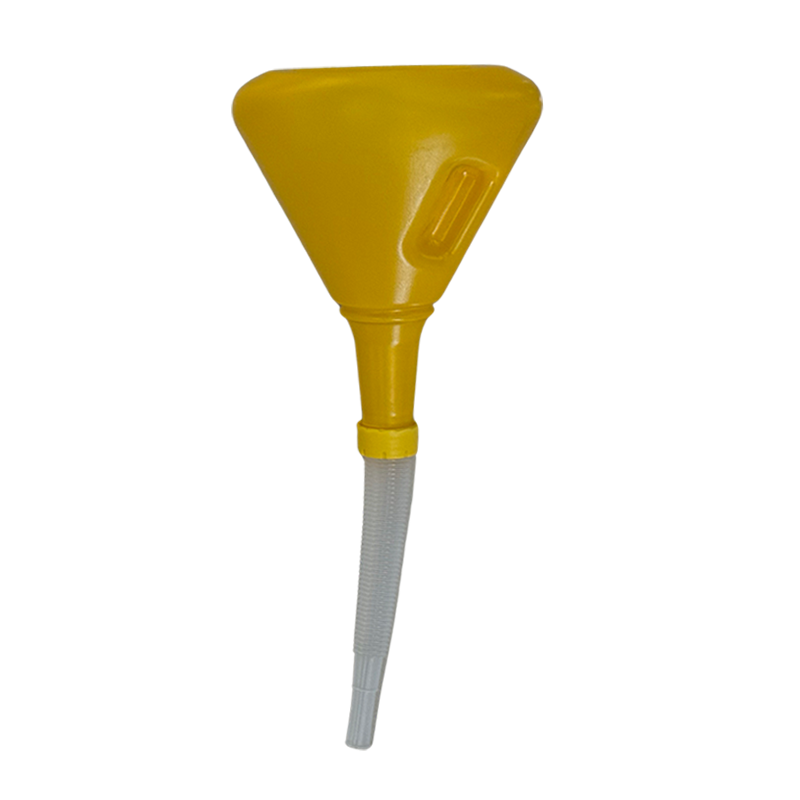
Different industrial sectors leverage conical geometry to achieve specific operational outcomes. By matching the physical properties of the funnel to the demands of the process, facilities can optimize their material handling workflows.
Chemical manufacturing relies heavily on conical geometries, sharing design principles with bulk conical storage tanks. The primary advantage in these environments is the elimination of dead zones and pooling. Flat-bottomed containers often trap residual chemicals, but the sloped walls of a conical design ensure complete drainage. This characteristic minimizes the risk of batch-to-batch cross-contamination, which is paramount in high-purity chemical synthesis.
This geometric advantage scales seamlessly across the facility. Laboratory glass funnels use the exact same drainage principles as heavy-duty industrial charging ports on massive reactors. Whether handling a few milliliters of a catalyst or hundreds of liters of a precursor chemical, the conical shape guarantees that the entire intended volume reaches the reaction vessel.
Industrial filtration systems frequently utilize conical funnels for standard clarification processes. The internal slope provides uniform structural support for filter paper or mesh screens. When hydrostatic pressure builds as liquid fills the funnel, the conical walls distribute this force evenly across the filter medium, preventing tearing or rupturing.
Unassisted gravimetric filtration offers significant cost-efficiency. Because the process relies entirely on gravity and the funnel's geometry, it requires no external vacuum pumps, complex seals, or pressurized vessels. This simplicity reduces equipment maintenance, lowers energy consumption, and provides a highly reliable method for separating solids from liquids in standard processing environments.
Handling dry materials requires modified conical designs. While liquids flow easily, powders and granules are subject to internal friction and cohesion. The slope angle of the funnel must be carefully matched to the angle of repose of the specific powder being transferred. If the angle is too shallow, the material will stall and build up on the walls.
By specifying a funnel with a slope steeper than the material's angle of repose, operators maintain continuous flow into narrow-mouth receptacles without blockages. This ensures that granular raw materials, pharmaceutical powders, or agricultural additives transfer smoothly, preventing costly production delays caused by manual intervention to clear clogs.
Engineers and procurement teams must evaluate several physical dimensions and material properties to specify the correct funnel for their equipment. A mismatched funnel will immediately create bottlenecks and safety hazards.
Selecting the correct cone angle is the first step in integration. A 60-degree angle is standard for filtration because it perfectly accommodates folded filter paper and provides an optimal balance of volume capacity and flow velocity. However, highly viscous fluids may require steeper angles to maintain acceptable throughput.
The mathematical relationship between the funnel's upper diameter, cone angle, and expected flow volume dictates the transfer speed. A wider upper diameter increases the initial holding capacity, while the cone angle determines how rapidly that volume is converted into downward pressure. Engineers must calculate these variables against the viscosity of the fluid to prevent overflow and ensure the production line moves at the required pace.
Material composition dictates the funnel's operational lifespan and safety profile. Procurement teams must match the construction material to the specific chemical and thermal demands of the process.
| Material Type | Key Characteristics | Ideal Industrial Applications |
|---|---|---|
| Borosilicate Glass | High thermal shock resistance, transparent. | Visual process monitoring, laboratory-scale gravimetric filtration, high-temperature transfers. |
| Stainless Steel (304/316L) | Corrosion resistant, high durability, sterilizable. | High-impact industrial environments, sanitary/food-grade compliance, heavy-duty processing. |
| Industrial Plastics (PTFE, HDPE) | Chemical inertness, lightweight, shatter-proof. | Handling highly corrosive acids, portable field applications, environments where glass is prohibited. |
The stem length significantly affects capillary action and overall flow rate. Long-stem funnels excel at directing flow deep into receptacles, which prevents splashing at the bottom of the container. Furthermore, a long stem filled with liquid creates a continuous fluid column; the weight of this column exerts additional downward pull, slightly increasing the filtration or transfer rate.
Conversely, short-stem funnels are better suited for viscous liquids or slurries, as they reduce the distance the thick material must travel, thereby preventing clogging within the tube. The terminating narrow tube diameter must also be carefully specified to control flow velocity and ensure a perfect fit with the receptacle entry ports, avoiding instability during the pour.
Validating a purchasing decision requires comparing conical funnels against other standard industrial geometries to ensure the selected equipment matches the specific process requirements.
Conical funnels operate on gravity-fed principles, making them ideal for simple, unassisted liquid transfer and standard filtration. In contrast, Büchner funnels feature a flat-bottomed, perforated design and are explicitly engineered for vacuum-assisted filtration. A Büchner funnel is required for the rapid separation of large volumes of solid-liquid slurries where gravity alone would be too slow.
If the process only requires basic clarification or liquid transfer, the conical design suffices and eliminates the need for expensive external vacuum equipment, collection flasks, and heavy-duty seals. Choosing a Büchner funnel for a simple gravity pour introduces unnecessary complexity and cleaning difficulties.
Standard conical funnels possess narrow-tube stems optimized for liquids. When operators attempt to pass coarse powders or damp granular materials through these standard stems, the material quickly compacts, causing bottlenecking and bridging. The narrow opening simply cannot accommodate the irregular shapes and friction of dry solids.
In these scenarios, a specialized wide-stem powder funnel is mandatory. Powder funnels maintain the conical upper body to direct the material but feature a significantly wider, shorter stem. This design allows dry bulk materials to drop straight through without compacting, ensuring continuous flow into the receiving container.
Integrating funnels into continuous processing lines presents practical challenges. Anticipating these physical realities allows engineers to implement effective mitigation strategies before production begins.
When transferring dry bulk materials, cohesive powders frequently form physical arches across the funnel stem (bridging) or create a hollow core where only the center material flows out (rat-holing). Both phenomena halt production and require intervention.
Mitigation strategies include specifying funnels with much steeper cone angles to overcome the material's internal friction. Additionally, integrating mechanical vibrators onto the funnel exterior breaks the surface tension of the powder. Applying non-stick internal coatings, such as PTFE, further reduces wall friction and promotes a smooth, continuous discharge.
Vapor lock occurs when a funnel stem perfectly seals the opening of a narrow receptacle. As liquid enters the container, it displaces the existing air. If the air cannot escape, pressure builds inside the receptacle, eventually causing the liquid flow to cease completely, leading to hazardous backups and spills.
To mitigate vapor lock, operators should select fluted funnels or funnels with ribbed stems. These external ridges prevent a perfect seal, creating small channels that allow displaced air to vent safely outward as the liquid flows inward. Alternatively, utilizing specialized venting adapters between the funnel and the container achieves the same result.
Large-scale industrial funnels experience severe mechanical stress, particularly at the junction where the wide cone meets the narrow stem. When filled with high-density fluids or heavy metal powders, this junction bears the entire hydrostatic and gravitational load, making it a common point of failure.
Mitigation requires specifying reinforced stem joints and heavy-wall construction for industrial applications. For extremely high-volume loads, external support rings or custom mounting brackets must be engineered to hold the funnel by the upper cone, transferring the weight away from the vulnerable neck junction.
To properly install and maintain heavy-duty funnels, follow these field-tested steps:
Inspect the neck junction for micro-fractures before mounting the funnel into the support ring.
Align the stem precisely with the receiving vessel to ensure no lateral stress is applied during fluid transfer.
Secure the external support brackets, ensuring the weight is borne by the upper cone, not the stem.
Run a low-volume water test to verify venting and check for potential vapor lock.
Establish a routine inspection schedule to check for abrasive wear on the internal slope.
The conical funnel remains the industry standard for material transfer due to its unmatched balance of flow control, complete drainage, unassisted filtration capabilities, and geometric simplicity. By leveraging gravity and precise tapering, it solves the core challenges of industrial material handling without requiring complex mechanical additions.
Procurement and engineering teams should base their final selection on three core metrics. First, evaluate the material's viscosity or particulate size to determine the necessary stem diameter. Second, assess the required chemical compatibility to select the appropriate construction material. Finally, calculate the specific flow rate demanded by the production line to specify the correct cone angle and upper capacity.
To ensure successful integration, take the following actionable steps:
Consult your facility's engineering team to define the exact dimensional tolerances required, including cone angle, stem diameter, and straight rim height.
Request comprehensive material specification sheets from manufacturers to verify chemical and thermal compatibility before executing bulk procurement.
Conduct a small-scale pilot test with the actual process fluids or powders to confirm flow rates and identify any potential bridging or vapor lock issues.
Establish a standardized cleaning and inspection protocol to maintain the structural integrity of the funnel neck and ensure zero cross-contamination between batches.
A: The standard angle is typically 60 degrees. This specific geometry ensures a precise fit for standard folded filter paper and provides an optimal slope for gravity-driven fluid flow, balancing holding capacity with downward hydrostatic pressure.
A: Straight high rims increase the overall holding capacity and act as a containment barrier. They contain the turbulence generated during rapid, high-volume material transfers, effectively preventing splashing or dangerous overflow before the fluid enters the cone.
A: The gradual tapering of the conical design provides uniform, surface-wide support against the filter paper. As hydrostatic pressure builds from the liquid, the sloped walls prevent the wet, fragile filter medium from tearing or rupturing.
A: Prevent clogging by utilizing funnels with steeper cone angles that exceed the powder's angle of repose. Implementing wide-stem designs, applying non-stick internal coatings, and attaching external mechanical vibrators also effectively disrupt bridging and maintain continuous flow.
A: A standard conical funnel features a narrow tube stem optimized for directing liquid flow. A powder funnel utilizes a much shorter, significantly wider stem designed specifically to prevent dry, coarse materials from compacting and bridging during transfer.
A: Conical geometries provide complete drainage capabilities. The sloped walls prevent liquids from pooling at the bottom, eliminating dead zones and minimizing the risk of batch-to-batch cross-contamination in critical chemical processes.
A: A longer stem can create a continuous column of liquid. The weight of this unbroken fluid column adds gravitational pull, which can slightly increase the overall flow or filtration rate, provided that proper venting prevents vapor lock.


